
Newsletter: The Selfish Giving Manifesto for Nonprofit Partnerships 📕 ; Why Consistency Beats Campaigns 🔁 ; How Blogging is Your Nonprofit’s AI Insurance Policy 🥽
Writing about nonprofit–corporate partnerships for 20 years is long enough to watch ideas come and go. Long enough to see shiny tactics rise, fall, and get rebranded. And long enough to notice that, underneath all that noise, the same core principles keep showing up—again and again.
At some point, that started to bother me.
Not because the ideas were wrong, but because they were scattered across posts, talks, case studies, and conversations. I realized I hadn’t ever stopped to clearly say, “This is what I believe about partnerships. Full stop.”
So I finally did.
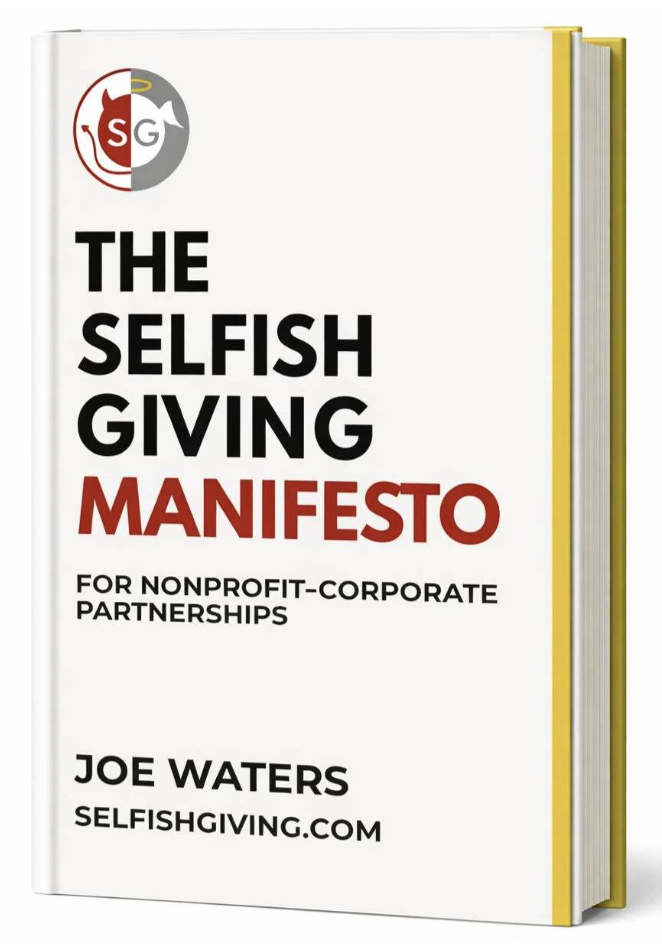
Today, I'm sharing The Selfish Giving Manifesto for Nonprofit-Corporate Partnerships—13 theses pulled from two decades of writing, experimentation, and real-world partnership work with nonprofits and companies. These aren’t trends or hot takes. They’re patterns. Things I’ve seen hold true whether an organization is big or small, well-staffed or stretched thin.
A quick confession: I didn’t do this entirely on my own. My blog has hundreds of posts. AI helped me step back, surface themes, and pressure-test clarity without losing my voice. Think of it less as outsourcing thinking and more as organizing a very full filing cabinet.
This manifesto isn’t finished—and it never will be. I expect to edit it, argue with it, subtract from it, and add to it as my thinking evolves and the partnership landscape changes. Consider it a snapshot of where I am right now.
Most importantly, this isn’t meant to be read once and admired. It’s meant to be challenged, debated, and applied. If it sharpens how you think about partnerships—or makes you a little uncomfortable in a useful way—then it’s doing exactly what it’s supposed to do.
Download: The Selfish Giving Manifesto for Nonprofit-Corporate Partnerships
I’ll be writing more soon about what this thinking has led me to build!
✍️ Partnership Notes
One partnership worth studying.
Consistency beats campaigns.
💡 Culver’s—the Midwest-based brand known for burgers and frozen custard—has donated more than $8 million to family farms through its long-running Thank You Farmers Project. But this isn’t a one-off. The company also supports agricultural education, FFA chapters, disaster relief, and local community causes across its footprint. That’s the real lesson: when a brand’s giving is tied to who they are, how they operate, and the people behind their product, impact compounds over time. Partnerships work best when they reinforce identity—not when they chase moments.
🤑 Marketing Your Cause
One move nonprofits should steal.
Blogging—yes, blogging—is your nonprofit’s AI insurance policy.
💡 As search shifts toward AI summaries and zero-click answers, original writing isn’t fading—it’s becoming source material. AI systems increasingly rely on lived experience, real examples, and documented thinking to decide what gets surfaced. For nonprofits, that means blogging isn’t about volume—it’s about recording what you actually know: partnerships, experiments, and lessons learned. If you want to be discoverable and trusted in 2026, a smart blog isn’t optional—it’s infrastructure.
😎 Cool Jobs in Cause
Find your next adventure.
Director of Corporate Partnership, The Headstrong Project, Remote ($100k-$130k)
Senior Dir., Business Development, Lincoln Center for the Performing Arts, NYC
Director, Corporate Development (East Region), Susan G. Komen, Remote ($102k-$145k)
🧠🍌 Brain Food
What's feeding my thinking.
The “best” AI chatbot depends on what you’re trying to think through. 🎁
💡 This roundup compares today’s major AI chatbots and lands on an unsatisfying—but honest—conclusion: there’s no single winner. Some tools are better for research, others for writing, others for brainstorming or coding—and each reflects the values and tradeoffs baked into it. The bigger takeaway isn’t which chatbot to pick, but how intentional you are about why you’re using one. AI isn’t replacing thinking. It’s exposing whether you know what kind of thinking you actually need.
