
In my last newsletter, I shared The Selfish Giving Manifesto. It's my attempt to share two decades of writing, experimentation, case studies, and conversations into a short list of ideas—13 theses—that actually endure.
Not tactics. Not trends. Just the truths I keep seeing repeat.
But my Manifesto faces the same problem as most: it doesn’t fully address the day-to-day realities nonprofits face.
I may have left you thinking, “Okay…now what?” (Sorry about that.)
That question is exactly what I’ve been thinking about.
Because here’s the uncomfortable truth: most nonprofits are told to build partnerships without a clear, realistic path to doing so. They’re given advice that assumes capacity they don’t have, audiences they haven’t built, and proof they can’t yet show.
Meanwhile, the nonprofits that do succeed with partnerships tend to follow a pattern—often without realizing it. They build credibility first. They show results. They document what worked. And they use that proof to attract the next opportunity.
In other words, partnerships don’t create momentum. They follow it.
That realization pushed me to begin developing a practical response to this gap—one grounded in how partnerships actually form, not how we wish they did.
What’s emerging for me isn’t a program, a framework, or a funnel.
It’s a system—designed to help nonprofits move from readiness, to proof, to momentum without overreach or burnout.
At its core, this system recognizes a few simple truths:
Not every nonprofit is ready for partnerships today
Proof beats pitching every time
Case studies aren’t just stories—they’re strategic assets
Sustainable partnerships are built step by step, not all at once
In the coming weeks, I’ll start sharing more about this system and how it works in practice. I’m calling it The Partnership Proof System, and it has three parts.
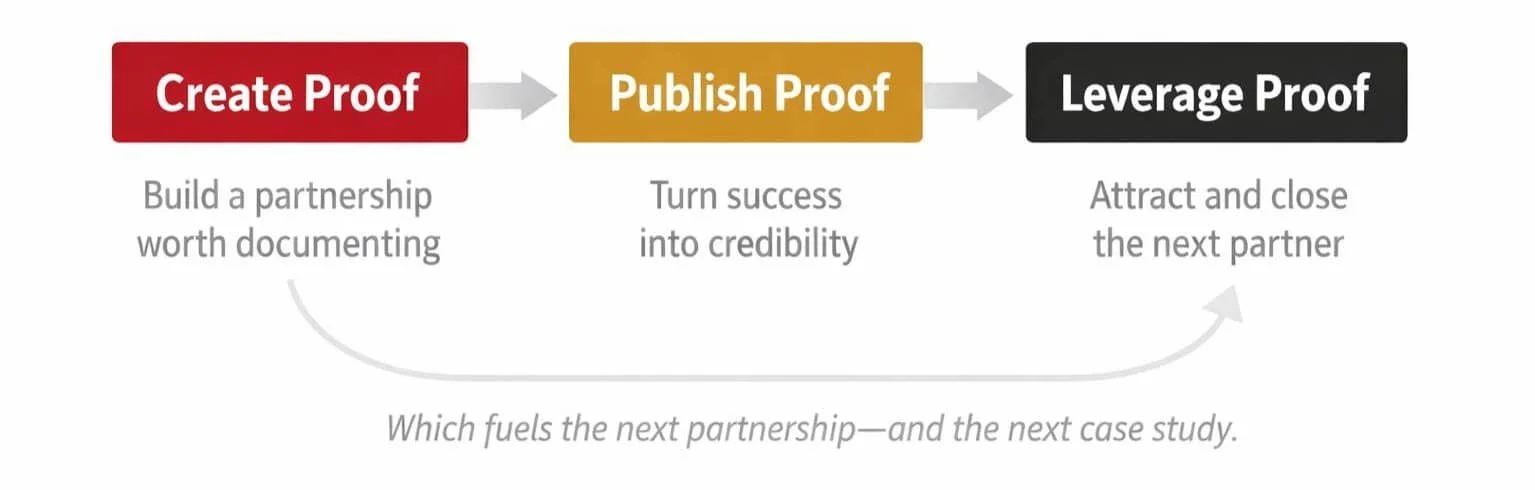
It unfolds in stages—each one building on the last—so nonprofits can meet partnerships where they are, not where someone else thinks they should be.
For now, consider this an invitation to think differently.
If my Manifesto sharpened your thinking—even a little—it’s doing its job.
If it raised questions about where partnerships actually fit in your organization, that’s a good sign.
More next time on stage one: the Partnership Proof Builder.
✍️ Partnership Notes
A partnership insight that matters.
Partnership work is sales—even if you don’t like the word.
💡 The author of this article makes a simple but uncomfortable point: avoiding “sales” doesn’t make persuasion disappear—it just makes it less intentional. That lands squarely in the nonprofit partnership world, where many professionals see themselves as relationship builders, educators, or advocates, but not sellers. The reality is that partnership success depends on clearly articulating value, asking directly, and helping the other side say yes without confusion or guilt. The insight that matters: reframing sales as service—helping the right partner make a good decision—often unlocks more honest, effective partnerships than hiding behind softer language.
🤑 Marketing Your Cause
One move nonprofits should steal.
Boring visibility beats clever campaigns when the stakes are high.
💡 This article explains why personal-injury lawyers pour money into billboards: when people need them, it’s urgent, emotional, and not the moment for clever comparison shopping—familiarity wins. That same dynamic plays out at checkout when shoppers are asked to donate; they say yes to causes they already recognize and trust, not ones they’re meeting for the first time. Superstar charities like St. Jude win because they're ubiquitous—people don’t need to think twice. The takeaway for you is that consistent, almost boring visibility builds mental availability, turning moments of action into real results. Again, when it comes to marketing, a workhorse beats a show horse every time.
😎 Cool Jobs in Cause
Find your next adventure.
1. Director, Strategic Partnerships, Pratham USA, Remote in California ($80k-$100k)
2. Corporate Giving and Volunteer Partnerships Officer, Emerald Necklace Conservancy, Boston ($70k-$90k)
3. Manager, Corporate Philanthropy, Music Will, Remote ($77k-$82k)
🧠🍌 Brain Food
What’s feeding my thinking.
Corporate purpose is at a fork in the road—and 2026 forces a choice.
💡 This Fast Company piece from Carol Cone argues that corporate purpose is entering a make-or-break moment. Companies can either double down on purpose as a core operating principle—or quietly reframe it as optional messaging once pressures mount. What stuck with me is the idea that purpose can’t survive as vibes or slogans; it has to be embedded in decisions, incentives, and tradeoffs when things get uncomfortable. For nonprofits and partnership teams, it’s a useful reminder: the strongest corporate partners won’t be the ones talking loudest about purpose—but the ones willing to pay for it, protect it, and act on it when it actually costs something.
