
Newsletter: How Partnerships Actually Get Approved ✅ ; Pest Control Company Shows How Local Partnerships Work 🦟 ; If AI Can’t See You, You Don’t Exist 🧑🦯
Most nonprofits think the key to partnerships is finding the right alignment.
Does the company share our values? Do they care about the same issues? Would this partnership make sense for their brand?
Those are the right questions to ask. Alignment matters.
The fact is, if you’re already sitting in a meeting with a company, there’s a good chance alignment already exists. The company already believes your organization could make sense for them.
But here’s the part that often gets overlooked.
👉🏻 Alignment gets you in the room. It rarely gets you the deal.
Once that hurdle is cleared, the conversation shifts.
Now the company is looking for proof.
Proof that customers will participate.
Proof that employees will engage.
Proof that the partnership will generate real results.
Inside most companies, someone has to champion the partnership internally—to marketing, leadership, or a buying committee. Alignment may open the door, but proof is what helps that internal champion move the idea forward.
That’s exactly what I’ll be talking about on Thursday at the Corporate Partnerships Conference (CPC26) in my session, From Pitching to Proof: A Smarter Way to Build Partnerships.
Partnerships usually follow a simple path:
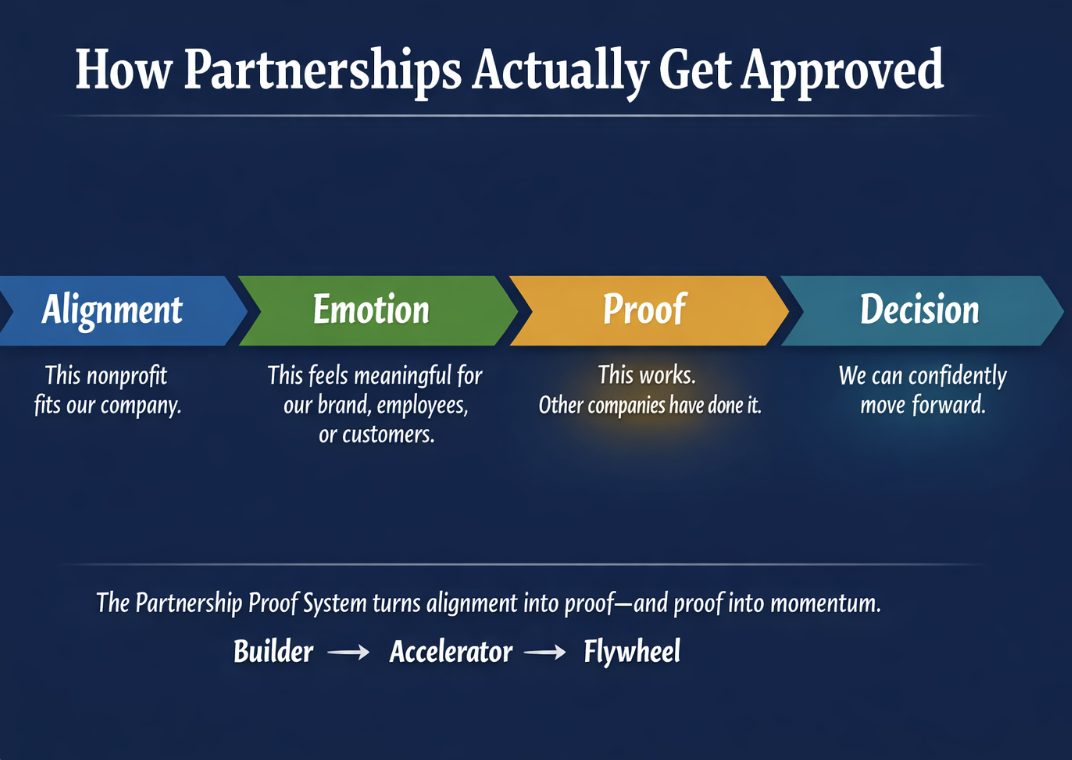
Here’s what’s interesting about that sequence.
Alignment usually isn’t the hard part. Sometimes it's obvious. A restaurant tackling food insecurity or an outdoor brand supporting conservation doesn’t require much explanation.
Emotion isn’t the hard part either. Nonprofits are incredibly good at telling stories that make people care.
The hard part—the part that determines whether the partnership actually happens—is proof.
Because sooner or later, someone asks the question that really matters:
“Has this worked before?”
That’s why the nonprofits that consistently land strong partnerships don’t just pitch ideas. They build visible proof that partnerships work.
This is the idea behind what I call the Partnership Proof System—a framework for turning alignment into evidence that attracts future partners.
In my session at CPC26, I’ll walk through how to move from constantly pitching partnerships to building the kind of proof that makes them easier to secure over time.
Because in the end, the organizations that win the most partnerships aren’t the ones with the best pitch.
They’re the ones who can show the best proof.
✍️ Partnership Notes
Two partnership insights that matter.
🏗️ Mission alignment is essential, but it's only the starting line.
A worthwhile read from Engage for Good digs into why mission alignment is important for long-term nonprofit–corporate partnerships. The article goes deeper than I typically do on alignment—highlighting shared values, leadership buy-in, and internal champions as the foundation for partnerships that last. It’s a helpful reminder that alignment isn’t just a checkbox—it’s what makes a partnership make sense in the first place. But here’s the catch: once multiple nonprofits meet that bar, alignment alone doesn’t win the deal. Companies still need proof that the partnership will actually work. Alignment opens the door—proof is what usually pushes the decision across the finish line.
🦟 A pest control company shows how local partnerships should work.
Green Pest Solutions donated $100,000 to Children’s Hospital of Philadelphia—but what’s especially smart is how they raised it: by tying donations directly to customer activity. The company pledged $25 for every customer who prepaid for 2026 services, turning everyday business into a fundraising engine. It’s also a great example of geographic alignment—the simplest and often most powerful kind. They serve the same community as the hospital, which makes the partnership intuitive, credible, and easy to support. Sometimes the best partnerships aren’t complicated—they’re just local.
🤑 Marketing Your Cause
One move you should steal.
If AI can’t see you, you don’t exist.
A new Content Marketing Institute piece highlights an emerging tactic called “generative engine optimization” (GEO)—the practice of getting your content cited in AI-generated answers, not just ranked in Google. That’s a big shift. AI tools don’t return lists—they return recommendations. And those recommendations are based on signals like authority, relevance, and how often your organization is mentioned alongside trusted sources. For nonprofits, this changes the game. It’s no longer enough to have a great website—you need proof, stories, and visibility across the web so AI sees you as a credible partner worth recommending.
😎 Cool Jobs in Cause
Find your next adventure.
🤝 Lead Manager, Corporate Alliances Account Manager, Make-A-Wish, Remote
🤝 Corporate Partnerships Manager, Upward Bound House, Santa Monica, CA
🤝 Assistant Director, Corporate Sponsorships, Boston College, Chestnut Hill, MA
🤝 Territory Director, Corporate Partnerships, Blood Cancer United, Northeast
🧠🍌 Brain Food
One thing that's feeding my thinking.
🔍 In a world where reality is up for debate, trust becomes everything.
A provocative piece in MediaPost argues that we’re entering a “war on reality,” where AI-generated content, deepfakes, and misinformation are making it harder to know what’s true. When everything can be manufactured, credibility becomes the most valuable signal. For partnership professionals, this raises the stakes. Companies aren’t just choosing partners based on alignment—they’re looking for organizations they can trust to be real, reliable, and reputable. In a noisy, synthetic world, proof isn’t just helpful—it’s how you stand out.
