
I’m talking about nostalgia today—with a little nostalgia of my own.
I first wrote this post several years ago. It was a big hit, so I’m bringing it back with some fresh pumpkin spice! 🎃🍂☕️
Have you noticed that pumpkin spice is like…EVERYWHERE?
Coffee, candles, cookies, cereal, donuts, dog treats, and even PEEPS (my favorite!).
👉 So, if everything has pumpkin spice in it this fall, shouldn’t your partnership strategy have a little pumpkin spice mixed in, too?
Before you conclude that the pumpkin has finally slid off Joe’s pumpkin spice-flavored cracker, hear me out.
This fall, tap into the nostalgia of your nonprofit’s brand.
Pumpkin spice isn’t really about pumpkins. It’s about the smells, tastes, and traditions that transport us back to a sweeter, simpler time.
Trick-or-treating with your kids. 👻
Baking pies with grandma. 🥧
Apple picking with friends. 🍎
But here’s something partnership professionals sometimes overlook.
Your nonprofit probably has its own version of pumpkin spice. Think about the memories, traditions, and campaigns people associate with your organization.
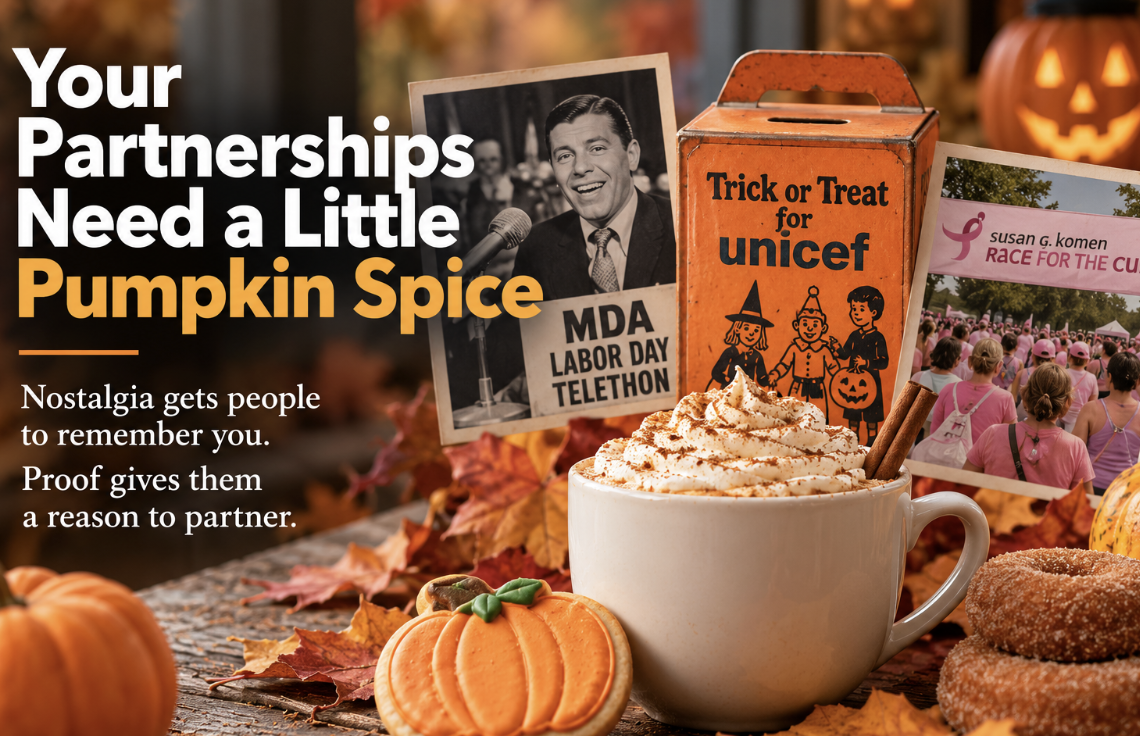
📺 Muscular Dystrophy Association: Remember the Jerry Lewis Labor Day Telethon? For generations of Americans, it was practically the unofficial end of summer.
💝 Susan G. Komen: Remember the first time you saw those pink ribbons in October? They helped make breast cancer awareness part of our national consciousness.
🎃 UNICEF: Remember carrying those little orange Trick-or-Treat for UNICEF boxes from house to house?
Well, UNICEF remembers, too! Last year, Trick-or-Treat for UNICEF celebrated its 75th anniversary. And this Halloween, the organization is inviting people to “Give Like a Kid Again.”
I love that.
UNICEF isn’t just celebrating its history. It’s inviting adults who remember those orange boxes to share the tradition with another generation.
That’s nostalgia doing something useful.
And there’s a lesson here for partnership professionals. Your organization’s history isn’t just something to celebrate at an anniversary dinner. It’s an asset you can use to connect with prospective corporate partners.
Maybe a company executive remembers participating in your signature fundraiser as a kid. Maybe their parents volunteered. Maybe your organization’s campaign was part of their family’s holiday traditions.
Those memories can create an emotional connection that a sponsorship deck full of demographics and logo placements never will.
Of course, nostalgia is relative. A Baby Boomer might remember the MDA telethon. A Millennial might remember collecting donations for UNICEF.
And Gen Z? Well, you’d better ask them. I’m an old, old, old Gen Xer. 😂
But here’s the important part.
Don’t stop at nostalgia. Connect those memories to what your nonprofit is accomplishing today.
The past creates the emotional connection. Today’s results give a prospective partner a reason to act.
Because it’s not enough for prospects to THINK a partnership makes sense. You want them to FEEL it, too. ❤️ And then you need to show them the proof.
Nostalgia gets people to remember you. Partnership proof gives them a reason to work with you today.
No, your prospect won’t smell pumpkin spice when you share the right story. But they might feel something even better. And that warm, sentimental feeling could be just the stirred-in goodness you need to seal the deal.
Sugar and spice and everything nice. That’s what partnerships are made of!
✍️ Partnership Notes
A partnership insight that matters.
🏅 What if your next corporate partner became your customer?
The organizers of the 2028 Los Angeles Olympics have teamed up with Homeboy Industries, a nonprofit that provides employment and rehabilitation opportunities for formerly incarcerated and gang-involved individuals. Through a new initiative called Made for Two-Eight, Homeboy’s silk-screening business will produce officially licensed Olympic merchandise featuring artwork by Fabian Debora, who leads Homeboy’s Art Academy. Homeboy gets access to a potentially enormous market, while LA28 gets locally produced merchandise with an authentic community connection. And the proceeds from Homeboy’s sales will help support its mission.
🔒 A paywall may stop you from reading this article. Just reply to this email, and I'll send you a copy.
Joe’s Take: When nonprofits think about corporate partnerships, they usually think about donations, sponsorships, or employee volunteering. But here’s another possibility: What if your nonprofit became a company’s vendor? Many nonprofits operate businesses that provide catering, printing, landscaping, cleaning, training, and other services. Those businesses can create opportunities for corporate partnerships that generate revenue while advancing the nonprofit’s mission. Homeboy Industries isn’t asking LA28 for a donation. It’s providing something LA28 needs. Sometimes the best corporate partnership isn’t about getting a company to give you money. It’s about giving the company a reason to spend money with you.
🤑 Marketing Your Cause
One move you should steal.
⚰️ Who says serious subjects can’t be funny?
Just in time for Halloween, casket company Titan has teamed up with Cup Noodles to create a limited-edition coffin promoting its new Vampire Noodles. Yes, really! The $3,999 casket features blood drops, the Cup Noodles logo, and the words “It’s to die for” embroidered inside. But this isn’t Titan’s first brush with dark humor. It also sells a Pumpkin Spice Casket and produces Grave Conversations, a YouTube series that interviews celebrities while they lie in coffins. The videos have attracted more than 19.8 million views. Behind the laughs is a serious business strategy: Titan wants people to know they can buy caskets directly, often for substantially less than funeral homes charge.
Joe’s Take: Nonprofits tackle some pretty serious subjects. Poverty. Disease. Hunger. Death. And we often assume our marketing needs to be just as serious. But Titan offers a different lesson: You can take your mission seriously without taking every piece of marketing seriously. Humor can make uncomfortable subjects approachable, spark conversation, and open the door to conversations they might otherwise avoid. Of course, there’s a difference between making light of a difficult subject and making light of the people affected by it. But sometimes a little levity is exactly what gets people to pay attention. The subject may be serious. Your marketing doesn’t always have to be.
😎 Cool Jobs in Cause
Find your next adventure.
🤝 Advisor, Corporate Business Development, St. Jude Children's Research Hospital, Nashville, TN
🤝 Vice President, Corporate Development & Partnerships, FourBlock, Remote
🤝 Corporate Philanthropy Officer, Engineers Without Borders, Denver, CO
🧠🍌 Brain Food
One thing that is feeding my thinking.
✍️ If AI can write, why is Anthropic paying $345,000 for a writer?
Anthropic, the company behind Claude AI, is hiring an executive communications writer for a salary of up to $345,000 a year. Yes, the company building technology that can write almost anything still wants a human writer—and is willing to pay handsomely! But the job isn’t simply about crafting beautiful sentences. Anthropic wants someone who can challenge executives, sharpen their thinking, understand complex ideas, and decide what’s worth saying in the first place. As marketing and writing expert Ann Handley observes, “When speed becomes cheap, judgment carries a premium.”
Joe’s Take: This is a useful reminder for nonprofit communicators. AI can draft your appeal, newsletter, annual report, or corporate partnership proposal in seconds. But should you send it? Is the argument compelling? Are the claims accurate? Does it reflect what makes your organization different? Will it actually persuade someone to act? Those questions require judgment, experience, and an understanding of your audience. The lesson isn’t that writing no longer matters. It’s that the thinking behind the writing matters more than ever. Don’t just become better at producing content. Become better at deciding what deserves to be said.
