
Newsletter: Want Better Sponsors? Skip the Gala 🍽️ ; B2B Partnerships Can Raise Money for Your Cause, Too ⚖️ ; What Happens When AI Does the Work, But Nobody Learns 🤔
What if your nonprofit’s next big event wasn’t so big? Would you actually land better sponsors?
What if, instead of organizing another gala, Halloween party, or elaborate fundraiser, you simply invited 30 or 40 carefully selected people to dinner?
No auction. No entertainment. No months of planning.
Just good food, interesting people, and meaningful conversations.
That’s one of the ideas I’ll be exploring during my next LinkedIn Live with sponsorship expert Larry Weil (aka The Sponsorship Guy).
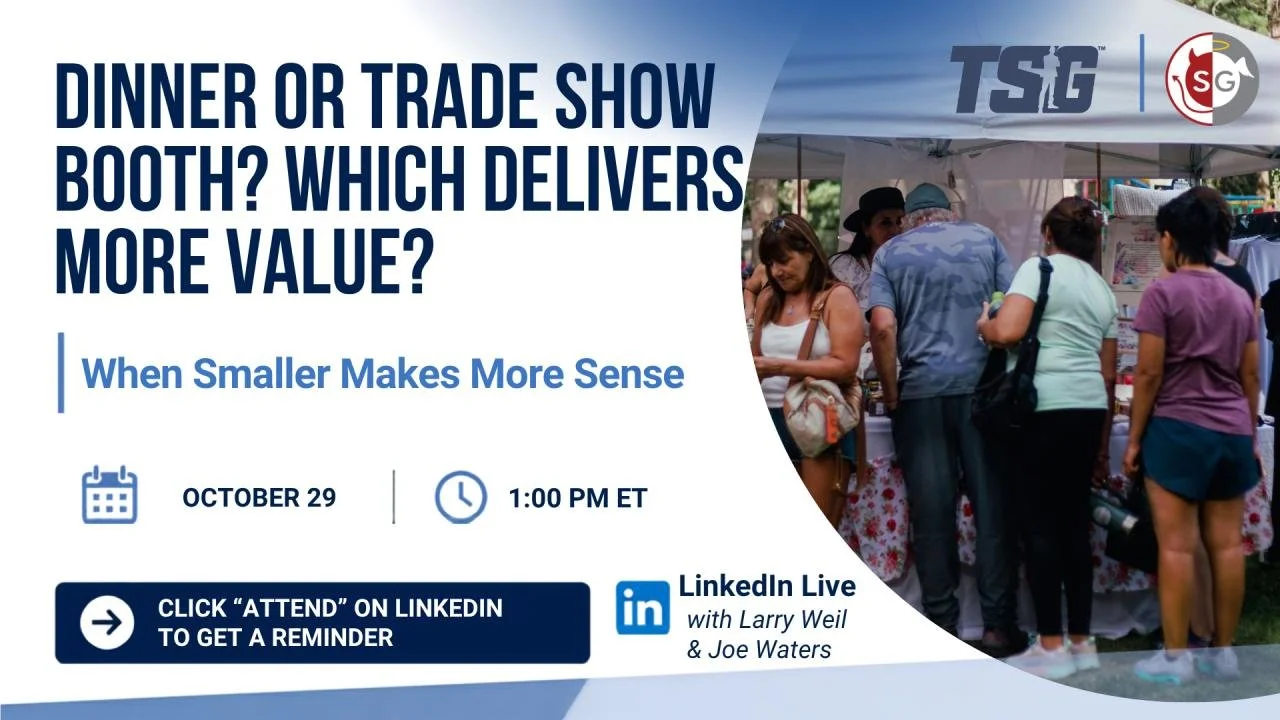
Larry has been watching an interesting trend in the conference and trade-show world.
Instead of spending tens of thousands of dollars on booths, signage, swag, and elaborate activations, some companies are investing in intimate dinners with carefully selected customers and prospects.
Larry’s argument? Dinner may be better than a booth at a conference.
And I started wondering: Why stop with trade shows?
Nonprofits spend enormous amounts of time and money organizing events. Some are terrific fundraisers, but others leave staff and volunteers exhausted and wondering whether the work was worth it. I've been on both sides! I bet you have too.
What if we occasionally traded the big event for a smaller, more intentional gathering?
And here’s where this gets really interesting for sponsorship.
We usually sell sponsorships based on attendance. But what if the better question is WHO will attend?
Think about it from a company’s perspective. Would you rather sponsor a gala with 300 people you don’t know or an intimate dinner with 30 people you’d love to meet?
Suddenly, the smaller event might be the more valuable sponsorship opportunity.
You’re not selling access to a crowd. You’re selling access to the right people.
Of course, the guest list matters. A dinner with 30 random people isn’t necessarily more valuable than a gala with 300. The opportunity comes from bringing together people who have a good reason to meet.
And dinners aren’t the answer to everything. A successful gala can raise serious money, build community, and introduce a cause to hundreds of new supporters.
But maybe we’ve become too accustomed to thinking that bigger events automatically create bigger opportunities.
Larry and I will explore whether nonprofits should rethink traditional events, what makes smaller gatherings attractive to sponsors, and how to create a dinner that’s valuable for everyone around the table.
Larry will bring the B2B perspective. I’ll bring the nonprofit perspective.
And we’ll tackle a question that matters to both:
What if the most valuable thing you can offer a sponsor isn’t a bigger audience—but a better conversation?
👉 Click "Attend" on LinkedIn to receive a reminder
✍️ Partnership Notes
A partnership insight that matters.
⚖️ B2B companies can raise money for your cause, too.
Employment law firm Jackson Lewis raised $127,990 for Feeding America during Hunger Action Month, helping provide an estimated 1.28 million meals. Instead of asking shoppers to donate at checkout, the firm ran a nationwide fundraising competition among its attorneys and employees, inviting clients, alumni, and friends to participate. Jackson Lewis also matched donations, doubling their impact. It’s a good example of how a B2B company can mobilize its professional network to support a cause.
Joe’s Take: Yay! B2B corporate fundraising partnerships are a thing! But let’s keep this in perspective. If your goal is to raise millions through customer donations, B2C companies—especially retailers and restaurants—generally offer greater potential because they reach so many consumers. B2B companies usually can’t match that scale. But what they lack in consumer reach, they can make up for in professional relationships, employee engagement, and corporate giving. The lesson isn’t to pursue B2B companies instead of B2C companies. It’s to recognize that both can be valuable partners, but they bring different assets to the table.
🤑 Marketing Your Cause
One move you should steal.
👋 Your organization’s most interesting people might be invisible.
Joe Pulizzi recently took a cruise and was blown away by two performers. Naturally, he wanted to learn more about them. But the cruise line identified them only by their first names and last initial. No social media accounts. No websites. No way to follow their careers. Later, he watched a fascinating employee making naan bread in the ship’s restaurant. The cruise line shared more information about the oven than the person making the bread! Pulizzi argues that companies are missing enormous opportunities to build relationships through the people who make their organizations special.
Joe’s Take: Think about the people at your nonprofit who make a lasting impression. Your volunteers, program staff, researchers, educators, and community leaders. How many of them are practically invisible in your marketing? People connect with people, not just organizations. Introduce your audience to these individuals. Tell their stories. Give people opportunities to follow their work and stay connected. Sometimes the best way to build a stronger relationship with your organization is to help people build relationships with the people who make it special.
😎 Cool Jobs in Cause
Find your next adventure.
🤝 Senior Director, Partner Relations, American Diabetes Association, Remote
🤝 Vice President, Institutional Giving, Americares, Remote
🤝 Partnership Activation Manager, First Responders Children's Foundation, NYC
🧠🍌 Brain Food
One thing that is feeding my thinking.
🤖 What happens when AI does the work but nobody learns?
Mark Schaefer attended MAICON, a conference exploring the future of AI and marketing, and returned with some provocative predictions. One speaker suggested that AI could soon perform many of the cognitive tasks handled by marketing executives today. Another argued that employees should be using AI far more extensively. But the observation that caught my attention came from AI expert Paul Roetzer: “The risk is not that AI does the work. The risk is that AI does the work and we never learn from it.” As organizations delegate more work to AI agents, they risk losing the learning that happens when people tackle difficult problems themselves.
Joe’s Take: Think about someone using AI to research corporate partners, develop proposals, and write outreach emails. The work gets done, perhaps faster and better than ever. But does that person actually understand the companies they’re pursuing? Are they developing the judgment and experience that will make them better at their job? Or are they just approving work they don’t fully understand? The lesson isn’t to use AI less. It’s to use it more deliberately. Ask it to explain its reasoning. Challenge its recommendations. Compare its conclusions with your own. Share what you’re learning with colleagues. AI should help us develop better judgment, not replace the need for it. Because what good is smarter work if we’re not becoming smarter ourselves?
