
Newsletter: Will AI Take Your Partnership Job? 🧐 ; A Partnership Scaling Mental Health Services in Construction👷♀️ ; The Future of Corporate Giving is Partnerships 🤝
Short answer: No. But it will absolutely change what your job is. And if you’re not paying attention, it might replace how you work with someone who adapts faster.
Before I get into that, a quick note of thanks. I heard from a lot of you last week about my note on how I’m using AI in this newsletter—great questions, smart pushback, and a few “don’t go too far with it, Joe” warnings (fair!). I see my use of AI here as an ongoing experiment. This newsletter has always been a bit of a testing ground for me, and that hasn’t changed. So keep watching—both for how I’m using AI… and where I’m choosing not to use it. And honestly, that experiment is a perfect example of what’s happening more broadly: AI is compressing processes that used to take hours into something that takes minutes. The work isn’t disappearing, but how we do it is.
I was reading this weekend about how AI isn’t just automating tasks—it’s compressing entire workflows. When content, research, and execution become instant and inexpensive, the value doesn’t disappear—it shifts. It moves to the people who design the work, guide it, and validate it.
And the more I thought about it, the more I realized: This is exactly what’s happening in partnerships right now.
The middle is disappearing.
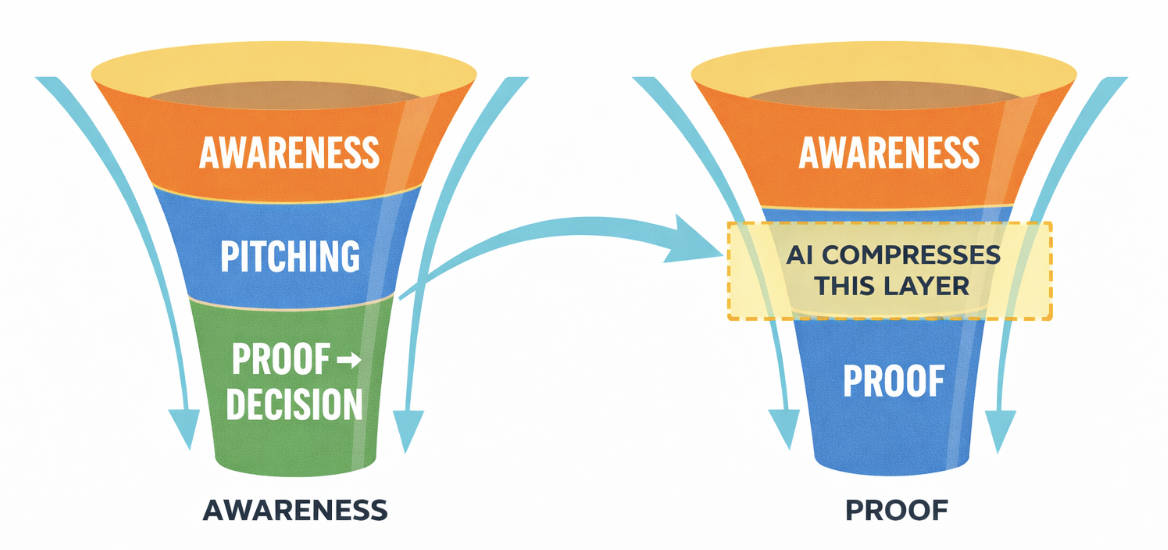
For years, the middle of the partnership funnel has been where most of the effort has lived. You know what I'm referring to: prospect research, outreach emails, pitch decks, proposals, etc.
Basically, all the stuff that was necessary and made you feel productive—and it was because there was no one else to do it.
Now? AI can do all of that. Faster, cheaper, and, yes, BETTER.
That doesn’t mean partnership jobs are going away. But it does mean a big chunk of what partnership people used to do is getting automated out of existence.
👉🏻 So...if everyone suddenly has access to decent outreach, polished decks, and halfway respectable ideas, then none of those things differentiate you anymore.
They become noise.
And when noise rises, trust becomes a scarce resource. That’s where proof comes in.
Now, let me clear about something: Proof has always been present and powerful, but now it’s doing all the work the middle used to do. In short, proof is #1. That's why I developed the Partnership Proof System.
Because AI can write your proposal, but it can’t prove your partnership worked. It can suggest ideas, but it can’t show results. It can mimic strategy, but it can’t replicate experience and evidence.
That’s why I think we’re seeing a major shift:
👉 Forms of outward proof are moving from the bottom of the funnel to the top
👉 Proof is replacing persuasion earlier in the process
👉 Partners aren’t asking “What can you do?” They’re asking, “What have you done?”
So…will AI take your job? AI won’t take your partnership job, but it will take the parts of your job that don’t require proof, judgment, or relationships.
And if you don't get good at those things, it will be adios amigo.👋
The future of partnerships isn’t about who can build the best deck or send the most emails. It’s about who can create real results and show them in a way that builds trust FAST.
✅ Less polish. More proof.
✅ Less pitching. More showing.
AI isn’t the end of partnership jobs. It’s the end of hiding behind busywork.💥
✍️ Partnership Notes
One partnership insight that matters.
👷♀️ The partnership that's changing how an entire industry works.
Hard Hat Courage brings together the American Foundation for Suicide Prevention and Bechtel—a global engineering, construction, and project management company—to tackle one of construction’s toughest challenges: mental health. But instead of a traditional campaign, this partnership is built for integration: Embedding training, tools, and conversations directly into jobsites. It’s also not just one company. The effort is backed by a broader coalition that includes major construction firms, unions, and industry groups, helping it scale across the workforce. There is funding behind it—Bechtel committed $7 million over five years—but the real value isn’t the dollars. It’s the design.
🤑 Marketing Your Cause
One move you should steal.
📢 If you want attention, stop avoiding real issues.
Retailers are leaning into perimenopause—a topic long overlooked despite affecting millions of women. Instead of avoiding it, brands are addressing it directly with products, messaging, and education. Nonprofits have been doing this for years. Groups like Movember, The Trevor Project, and Susan G. Komen (not to mention campaigns like Go Red for Women, Real Beauty, Hard Hat Courage, etc.) didn’t invent new problems—they gave specific, overlooked experiences a name, a voice, and urgency. The lesson for nonprofit marketers: relevance comes from recognition. When you speak clearly to real experiences, real pain—especially the ones others tiptoe around—you earn attention and trust.
😎 Cool Jobs in Cause
Find your next adventure.
🤝 Managing Director, Corporate Partnerships, Boys & Girls Clubs of America, Atlanta
🤝 Corporate Partnerships Manager, Mercy Ships, Remote
🤝 National Manager, Corporate Engagement, American Liver Foundation, Remote
🤝 Vice President, Corporate Partnerships, Shatterproof, East Coast Remote
🧠🍌 Brain Food
Two things that are feeding my thinking.
🔮 The future of corporate giving…isn’t giving. It's partnerships.
I say this all the time, but now I have some backup! A recent Harvard Business Review article argues that companies should rethink nonprofits, not as recipients of funding, but as partners that can create real business value. That’s a big shift. Instead of limiting relationships to grants or CSR, companies are looking for collaborations that engage customers, activate employees, and deliver measurable outcomes. In that world, traditional “giving” starts to look less relevant, and partnerships take its place. The nonprofits that win won’t just ask for support, they’ll show how they help companies succeed.
✊ Justice for em dashes!
Several of you commented last week that the em dashes in my newsletter are a telltale sign of AI and that I should cut back on them. There’s just one problem: I’ve ALWAYS used them—and I’m not stopping now.😄 Writing coach Ann Handley recently came to their defense, noting that great writers like Emily Dickinson used them freely (the Emily Dickinson Museum here in Massachusetts even pulled a fun April 1st stunt involving the em dash). In my case, I’ll also credit Romantic-era writers I've read like Lord Byron and Mary Shelley.
