
I’m speaking this week at Georgetown University’s New Strategies Program, and one topic I’m addressing head-on is the 1% floor on corporate charitable deductions imposed by the One Big Beautiful Bill Act. In simple terms, the first 1% of a company’s charitable giving is no longer tax-deductible. That’s a big shift, and it’s forcing companies to rethink their corporate giving strategies.
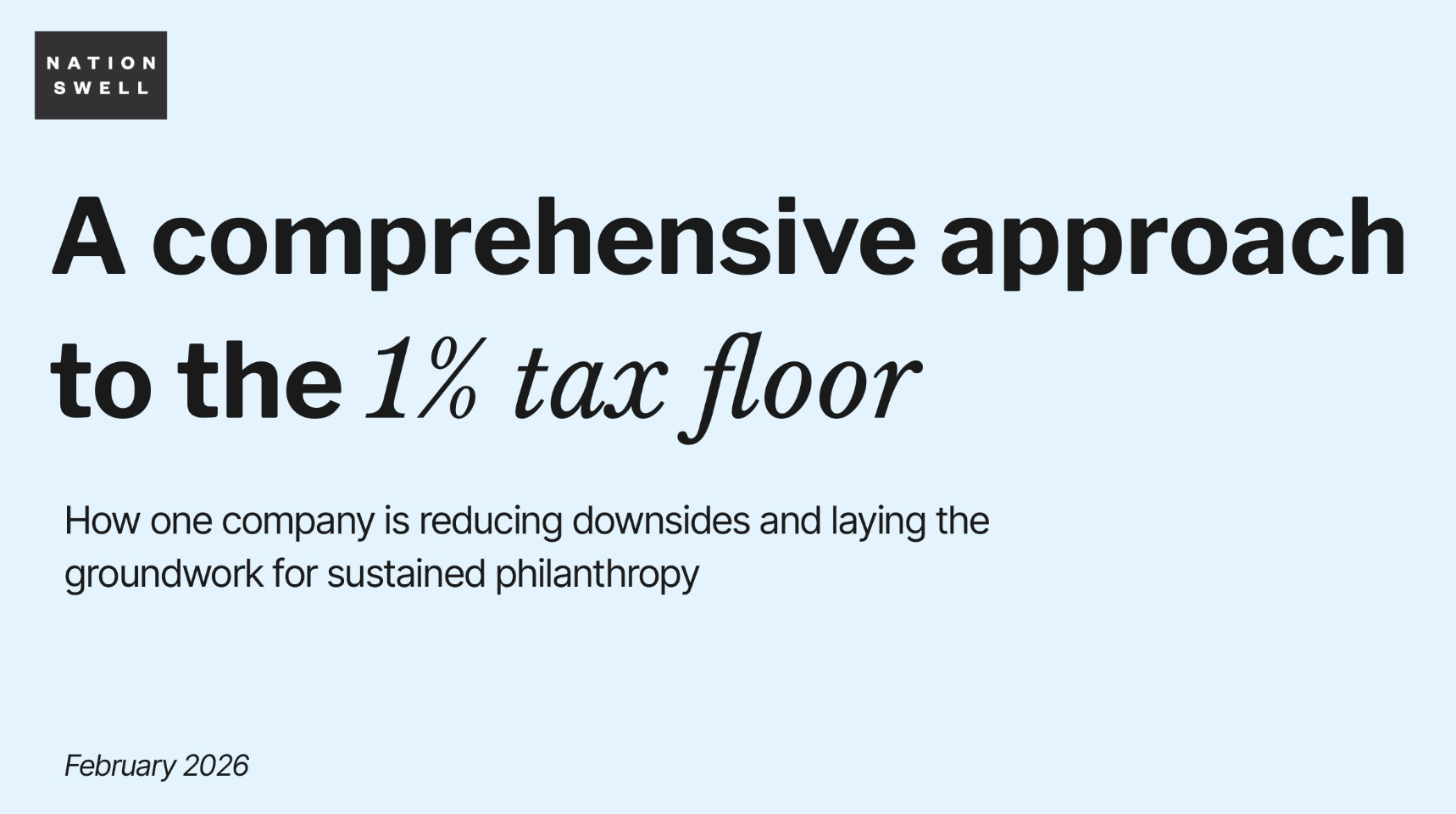
I came across an interesting NationSwell case study (you know I love a good case study!) that examines how one large company is responding. It lays out a multi-step approach, from aligning internal teams to modeling tax impact to rethinking how philanthropic dollars are deployed.
One idea that stood out: companies are exploring how to reclassify certain types of giving as ordinary business expenses, especially when there’s a clear connection to marketing, employee engagement, or brand value.
That’s the key insight.
Once something is framed as a business expense rather than a charitable donation, it plays by a completely different set of rules.
Now, before you run off and start redesigning your programs, a quick reality check.
I shared the NationSwell case study with my friend Curt Weeden, who knows corporate giving inside and out. Curt is also the founder of the New Strategies Program and the Association of Corporate Citizenship Professionals.
His take was measured (and wicked smahht): some of this is still a bit fuzzy, especially around things like donor-advised funds. The big takeaway, he said, isn’t the mechanics. It’s the shift in mindset.
👉🏻 Moving from charitable donations to business-aligned investments is where the real opportunity is.
And that’s exactly where partnerships come in.
Because partnerships (cause marketing, sponsorships, and employee engagement programs, etc.) are already built to deliver business value. They’re not just about giving money away. They’re about driving outcomes: customer engagement, brand affinity, employee retention, and community connection.
In other words, they already live on the “business expense” side of the line.
So while some organizations are scrambling to adjust their corporate giving strategies, partnership teams already have a head start.
My advice? Be more explicit about the business value you offer. As I'm telling the attendees at the New Strategies Program this week: Create it. Publish it. Leverage it.
Because in a world where traditional giving is getting squeezed, the organizations that win won’t be the ones asking for donations.
They’ll be the ones offering value.💥 And that’s not just a workaround for the 1% tax floor.
As Curt told me, "It’s a better strategy—period."
✍️ Partnership Notes
One partnership insight that matters.
💨 This partnership doesn’t just raise money—it shows up at the moment people need it most.
A cancer hospital is partnering with a grocery store to create an on-site food pantry for patients, addressing a very real yet often overlooked challenge: food insecurity during treatment. It’s a simple idea with a big impact. Instead of asking patients to navigate another system, the partnership brings support directly into the care environment, solving a problem at the exact moment it occurs. That's what great partnerships do!
🤑 Marketing Your Cause
One move you should steal.
🌳 Companies are looking for local visibility—parks and rec deliver it.
A recent piece highlights parks and recreation departments as one of the most undervalued sponsorship opportunities in the country. But the real insight for nonprofit teams isn’t just about sponsorship—it’s about where companies want to show up. Parks offer built-in audiences, community trust, and year-round programming without the competition (or cost) of major events. In other words, they function less like a venue and more like a hyper-local marketing channel, and exactly the kind of place companies look when they want to connect with communities in a visible, meaningful way.
😎 Cool Jobs in Cause
Find your next adventure.
🤝 Lead Director, Corporate Partnerships Strategy, BBBS, Remote
🤝 Senior Dir., Corporate Engagement, World Wildlife Fund, Washington, D.C.
🤝 Partnership Manager, Rise Against Hunger, Orlando, FL
🤝 Dir. of Corporate Partnerships & Events, Habitat for Humanity, Tampa, FL
🧠🍌 Brain Food
One thing that is feeding my thinking.
🤖 Your next “audience” might not even be human.
A fascinating—and slightly unsettling—article argues that as AI agents increasingly evaluate, select, and even purchase on our behalf, your “user” may no longer be a person at all. That changes everything. Agents don’t care about branding, onboarding, or clever messaging. They care about outputs, reliability, and results. In that world, anything built for human persuasion starts to lose its edge—and what actually works becomes much more obvious. How I see this through my partnership lens: if AI is helping choose partners, your story matters less, and your proof matters more.
