
Newsletter: The One-Two Punch of Winning Partnerships 🥊 ; The Best Cause Marketing Fits Into Existing Habits ⏰ ; AI is Making Credibility More Valuable—Not Less 💍
Every once in a while, I read something that doesn’t give me a new answer—it helps me ask a better question.
That happened recently when I read an article by Tamsen Webster, a messaging strategist based in Boston.
[Seriously, what is it with Boston? Every time I discover someone with a brilliant new way of thinking, they seem to live here. It’s getting a little weird.]
Her article wasn’t about corporate partnerships, but it made me rethink something I’ve been teaching for years.
Her point was simple: before people decide whether to trust you, they first decide whether your idea makes sense. It dawned on me that this happens all the time.
For example, someone is always showing up at my door selling something. Last week, it was solar panels. Now, solar panels may be a terrific investment, and I hope to have them one day. But my kids are grown, and I’m not sure how much longer I’ll be in my current house. The idea simply doesn’t make sense for me right now.
Once I reached that conclusion, it didn’t matter who was standing on my steps. They could have been the best salesperson in the Greater Boston area. They never had a chance because I rejected the idea before I ever evaluated the person presenting it.
That’s when it clicked for me. Companies do the same thing with partnership pitches. Before they evaluate you, they’re evaluating your idea. Just like the salesperson at my front door, if the idea doesn’t make sense, they may never get around to evaluating the person presenting it.
I’ve spent more than two decades arguing that companies don’t partner with nonprofits simply because they’re worthy. They partner because they believe the partnership will help them achieve something important. It’s the reason I named my blog Selfish Giving.
But Tamsen’s article made me realize I hadn’t fully explained where proof fits in the sequence of persuasion.
Over the past year, I’ve been developing what I call the Partnership Proof System—helping nonprofits use case studies, testimonials, data, partner logos, and other evidence to reduce risk and build confidence.
Most partnership professionals assume the first question a prospective partner is asking is:
“Why should we partner with your organization?”
I don’t think that’s the first question at all.
I think it’s this:
“How does this partnership help us achieve something we already care about?”
Before companies evaluate your organization, they’re evaluating your idea.
"Does it help us achieve an important business goal?"
"Will it create value for our employees, customers, or community?"
"Can I confidently recommend it to my leadership team?"
"Have we done this before? Did it work?"
Only after they see the business value do they start asking whether you’re the organization that can deliver it.
That’s where proof comes in.
I’ve come to believe every winning partnership proposal has to answer two questions.
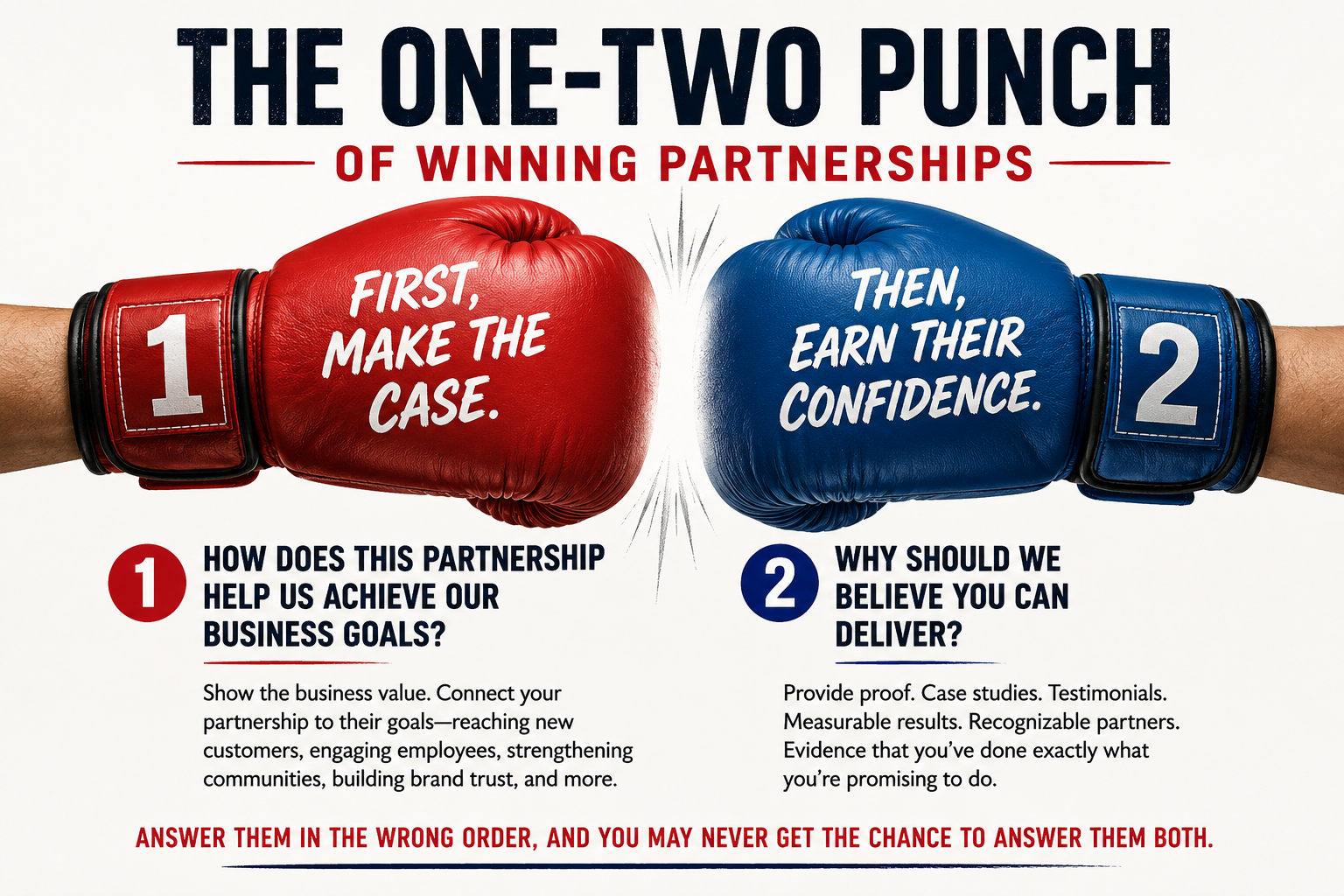
First, answer the question:
“How does this partnership help us achieve our business goals?”
Show companies how your partnership helps them solve a business problem or advance a priority they already have. Maybe that’s reaching new customers, engaging employees, strengthening community relationships, or building brand trust.
Then answer the second question:
“Why should we believe you can deliver?”
This is where proof becomes indispensable. Case studies. Testimonials. Measurable results. Recognizable partners. Evidence that you’ve done exactly what you’re promising to do.
That’s the one-two punch for winning partnerships.
First, make the business case.
Second, back it up with proof.
Proof answers, “Can you do it?” But only after you’ve answered, “Why should we care?”
✍️ Partnership Notes
Two partnership insights that matter.
☕ The best cause marketing fits into existing habits.
For one day each year, Tim Hortons donates 100% of hot and iced coffee sales to Tim Hortons Foundation Camps, which helps underserved youth develop leadership and life skills. The campaign has become one of Canada’s signature cause marketing events because participation couldn’t be simpler. Customers don’t have to buy a special product, round up their purchase, or enter a code. They just order the same cup of coffee they were already planning to buy.
Joe's Take: The best cause marketing campaigns don’t ask customers to change their behavior—they connect a cause to something people already do. That’s an important lesson for any partnership. The less friction you create, the more likely people are to participate. Instead of inventing new habits, look for ways to build your cause into existing ones.
☎️ The Sponsorship Insight Fast Company Missed. [REPLAY]
A recent Fast Company article on conference sponsorships sparked a great conversation between Larry Weil (The Sponsorship Guy) and me. It’s a good article, and you should read it. But we thought it was incomplete.
So, in our latest LinkedIn Live, we discussed what the article got right, where we’d add context, and why sponsorship decisions are often more complex than they appear.
🤑 Marketing Your Cause
One move you should steal.
🤖 AI is making credibility more valuable—not less.
As AI search tools like ChatGPT and Google’s AI Overviews become more common, marketers are rethinking what it means to be visible online. The new goal isn’t simply to publish more content—it’s to become a trusted source that AI consistently recognizes and cites. According to a recent MarketingProfs article, that means creating original ideas, developing memorable frameworks, sharing specific data, and earning repeated mentions from credible third-party sources.
Joe’s Take: This reinforces something I’ve been saying for months: AI isn’t replacing proof, it rewards it. Anyone can use AI to produce endless articles. What AI can’t manufacture is credibility. That’s why case studies, original research, testimonials, partner stories, and media mentions are becoming even more valuable. In an AI-driven world, the organizations with the strongest evidence—not the most content—will stand out.
😎 Cool Jobs in Cause
Find your next adventure.
🤝 Director of Corporate Partnerships, Center for the Rights of Abused Children, Phoenix, AZ
🤝 Business Development Manager, Children's Miracle Network, Salt Lake City, UT
🧠🍌 Brain Food
One thing that is feeding my thinking.
⚙️ Your new job may be managing the work—not doing it.
A fascinating essay from Every argues that AI is changing knowledge work in a fundamental way. Instead of using AI to complete one task at a time, professionals will increasingly build systems that gather information, propose decisions, execute approved work, and learn from feedback. Our role shifts from doing every task ourselves to supervising and improving the loop.
Joe’s Take: This resonated with me because it’s exactly how I’ve started using AI. I spend less time asking ChatGPT to write something from scratch and more time teaching it how I think, reviewing its work, and refining the process. The competitive advantage isn’t simply knowing how to prompt AI anymore. It’s designing better systems and exercising better judgment.
