
Newsletter: What Fast Company Missed About Sponsorship 🎯 ; The Best Partnerships Don’t Stop at One Activation 🚀 ; Never Build Your Marketing on Rented Land 📬
Every once in a while, I read an article that makes me stop and think:
“Wait a minute… I’m not sure I agree with that.”
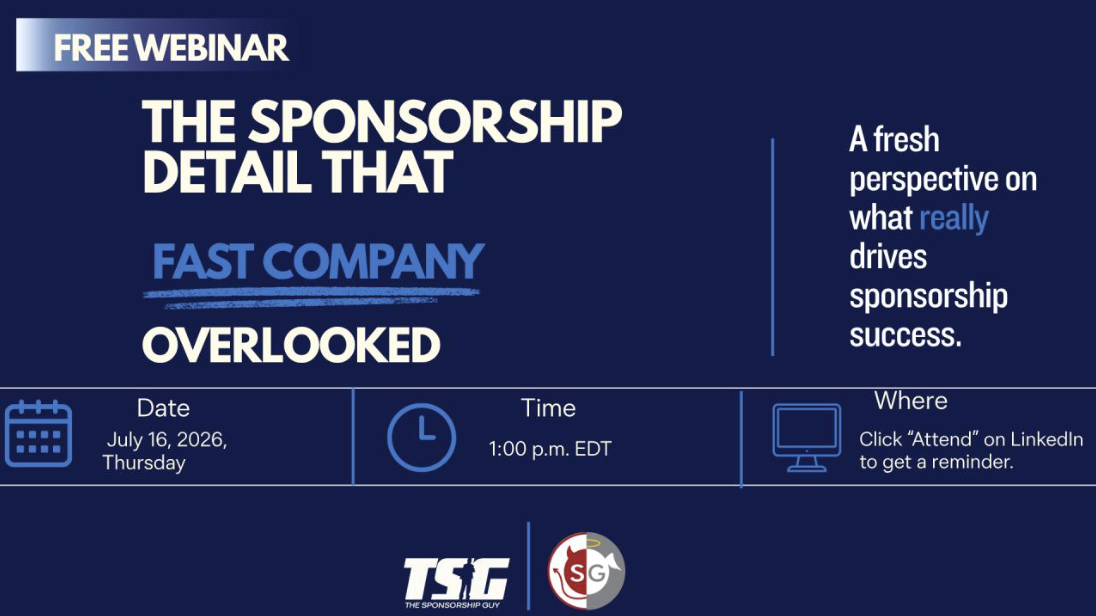
That’s exactly what happened when Larry Weil (aka The Sponsorship Guy) and I read a recent Fast Company article featuring executives explaining how they decide whether to sponsor conferences.
To be clear, it’s a good article. In fact, I recommend reading it.
But as Larry and I talked it through, we realized that some of the advice sounded right on the surface… yet didn’t align with what we’ve seen over decades of working with sponsors and sponsorship sellers.
That raised an interesting question:
What did the article get right—and what did it miss?
That’s exactly what we’ll explore in our next LinkedIn Live.
This isn’t a critique for the sake of criticizing.
It’s an opportunity to challenge a few assumptions about sponsorship that almost everyone—including experienced professionals—takes for granted.
If you want to sharpen your thinking about sponsorship, I think you’ll enjoy this conversation.
👉 Click “Attend” on LinkedIn to get a reminder
✍️ Partnership Notes
Two partnership insights that matter.
🥖 The best partnerships don’t stop at one activation.
Aspire Bakeries, home to the Otis Spunkmeyer brand, helped raise a record-breaking donation for the Sodexo Stop Hunger Foundation through Sodexo’s Spirit of Giving campaign. Rather than simply writing a check, the companies layered product promotions, employee engagement, and customer participation into a single partnership. The takeaway for nonprofits: every successful activation should spark the question, “What else?” Don’t limit a corporate partnership to one campaign or event. The strongest partnerships grow by finding new ways for employees, customers, and the community to participate over time.
🎆 Want bigger sponsorships? Build a bigger story.
Pittsburgh’s Fourth of July celebration attracted $350,000 in sponsorships by positioning itself as more than a fireworks show. It’s an engine for tourism, local business, community pride—and even cause marketing. One activation last week, the Piatt Companies Salute to Service Wheel, donated 50% of ticket sales to a local veterans nonprofit. The takeaway: sponsors don’t just fund great events. They fund platforms that create value for the community in multiple ways.
🤑 Marketing Your Cause
One move you should steal.
📬 Never build your marketing—or your audience—on someone else’s land.
A new study tracked 100 once-successful blogs and found the median site lost 85% of its Google traffic after search, and AI reshaped how people discover content. The survivors had one thing in common: they weren’t dependent on Google. They had built trusted brands, loyal email subscribers, and communities that followed them wherever they went. The takeaway for nonprofit marketers: every social platform, search engine, and AI tool is rented space. Your email list, your reputation, and your direct relationships with supporters are assets you own—and they’re becoming more valuable every day.
😎 Cool Jobs in Cause
Find your next adventure.
🤝 Associate National Director, Corporate Development, Breakthrough T1D, Northeast Remote
🤝 Director, Corporate Philanthropy, National Scleroderma Foundation, Remote
🤝 Senior Account Manager, Corporate Partnerships, National Park Foundation, Washington, D.C.
🧠🍌 Brain Food
One thing that is feeding my thinking.
🌱 Using AI responsibly starts with making it work less.
This article makes a practical point about AI’s hidden costs: every prompt has a financial cost and an environmental one. The biggest surprise is how much file formats matter. Simple formats like TXT, Markdown, and CSV are much easier for AI to process, while DOCX, PPTX, PDFs, spreadsheets, and images require far more energy and compute. The takeaway: draft, revise, and iterate in lightweight text first, then generate the polished file only when you’re ready.
BTW, I asked AI to evaluate my own habits using Andy’s recommendations. It gave me high marks (8.5–9 out of 10), noting that I primarily work in text and use AI to sharpen my thinking rather than replace it. That’s exactly the goal. Responsible AI use isn’t just about what you ask—it’s also about how efficiently and thoughtfully you ask it.
