
Newsletter: Your Best Sponsorship Sales Person is Another Sponsor🥇; A Yacht Partnership That Shares a Key Lesson 🛥️ ; When Should Nonprofits Say No to the Money? 💰
When you’re trying to land a new corporate partner, you can tell them all sorts of wonderful things about your organization.
You can tell them you’re a great partner. You can tell them you’ll deliver results. You can tell them other companies love working with you.
But there’s a problem.
You’re the one saying it.
It’s far more powerful when an existing corporate partner says it for you.
That’s the power of social proof—and it’s the topic of the next LinkedIn Live with sponsorship expert Larry Weil.
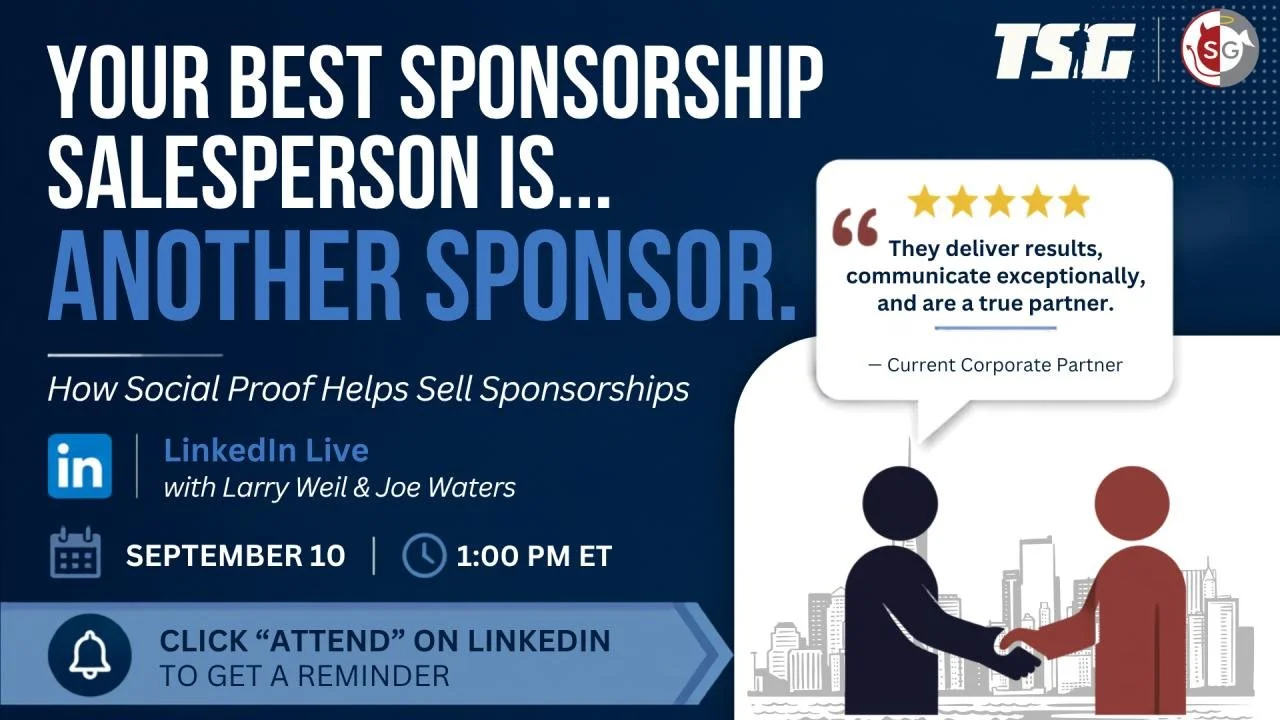
We’ll spend much of our time talking about my favorite form of social proof: case studies. A strong partnership case study doesn’t simply document what happened. It shows prospective sponsors what a successful partnership with your organization actually looks like.
And case studies aren’t the only form of social proof available to you.
Larry and I will discuss:
Why social proof matters so much in sponsorship sales—especially when a company is considering a new partner.
What makes a great sponsorship case study and why most organizations aren’t taking full advantage of the partnership stories they already have.
Why the best case studies focus on the sponsor’s results, not just the nonprofit’s impact.
How testimonials, partner logos, metrics, and other forms of social proof can strengthen your sponsorship marketing.
Where all this proof should live—from your website and sponsorship pages to proposals, presentations, emails, and sales conversations.
How to start building social proof even if you don’t have a library of polished case studies yet.
The goal isn’t to convince prospects that you’re a great partner simply because you say so.
It’s to give them enough evidence that they can come to that conclusion themselves.
Join Larry and me—and bring your questions!
👉🏻 Click "Attend" on LinkedIn to receive a reminder
✍️ Partnership Notes
A partnership insight that matters.
🌊 This yacht partnership has an important lesson for nonprofits.
The Superyacht People, an Australian yacht charter company, recently partnered with the International SeaKeepers Society to weave ocean conservation directly into its luxury travel experiences. Guests can participate in citizen science projects, support marine research, and learn about ocean conservation during their voyage. Instead of asking customers to support a cause after the experience, the partnership makes conservation part of the experience itself.
Joe’s Take: One of the biggest mistakes nonprofits make is treating partnerships as an add-on. The strongest partnerships don’t feel bolted on—they feel built in. Whether it’s a yacht charter, a retail promotion, or an employee engagement program, the more naturally your mission fits into the customer experience, the more valuable the partnership becomes. The best partnerships don’t interrupt what a company already does. They make it better.
🤑 Marketing Your Cause
One move you should steal.
⚔️ Maybe it’s time to stop “fighting” for your cause.
Nonprofits love war metaphors. We fight poverty, battle cancer, combat hunger, and wage war on injustice. But writing in The Chronicle of Philanthropy, Brian Gralnick argues that this language can backfire. Military metaphors may create urgency, but they can also make complex problems seem like battles with winners and losers—and turn off the very people you’re trying to engage.
Joe’s Take: Words matter. We use fighting language because it sounds strong and urgent, but strength doesn’t have to mean combat. Gralnick suggests words like champion, advocate, and work toward—language that invites people to participate rather than enlist for battle. Review your website, fundraising appeals, and partnership materials. How often are you asking people to fight something when you could invite them to build something better? That’s not just nicer language. It may be better marketing.
😎 Cool Jobs in Cause
Find your next adventure.
🤝 Director of Corporate Engagement, Wildlife Conservation Society, NYC
🤝 Director, Corporate Growth, Rise Against Hunger, Washington, DC
🤝 Corporate Partnerships Director, Trust for Public Land, Remote
🧠🍌 Brain Food
One thing that is feeding my thinking.
🍷 When should a nonprofit say no to the money?
The American Cancer Society has ended its longstanding Wine & Spirits Industry Gala after questions were raised about accepting money from an industry whose products increase cancer risk. That’s no small decision: the event had raised at least $22 million over the years. ACS says the move is part of an effort to ensure its fundraising activities align with its mission and cancer-prevention guidance.
Joe’s Take: This is a tough one. Every nonprofit has—or should have—lines it won’t cross when accepting corporate money. But those lines are a lot easier to draw when there’s no money on the table. What happens when the partnership has raised $22 million for your mission? I don’t think there’s a simple answer, but there is an important question every nonprofit should answer before the check arrives: Are there companies or industries we won’t take money from—and why? Because the worst time to figure out your values is when someone is offering you a big check.
