
Newsletter: Stage 2: Partnership Proof Accelerator 🚀 ; Keeping Your Content Raw Beats AI Efficiency 🥩 ; Why Partnerships Are No Longer Optional 📌
In 2026, persuasion won’t be the thing that wins partnerships—proof will.
That’s the argument coming out of The Drum, and it tracks perfectly with what I see every day in nonprofit–business partnerships. Companies are tired of pitches. They don’t want promises, positioning, or polished decks. They want evidence. Something real they can point to and say, this works.
In my last issue, I introduced you to the Partnership Proof Builder—the first stage of my Partnership Proof System. It’s designed for nonprofits that don’t yet have a partnership they can point to with confidence.
But what happens once you do have proof?
That’s where most organizations get stuck again.
They execute a solid partnership. Maybe even a great one. Then they move on.
No system.
No leverage.
No momentum.
They treat a successful partnership like a finish line—when it should be the starting gun.
That’s the problem the Partnership Proof Accelerator, the second stage of the Partnership Proof System, is built to solve.
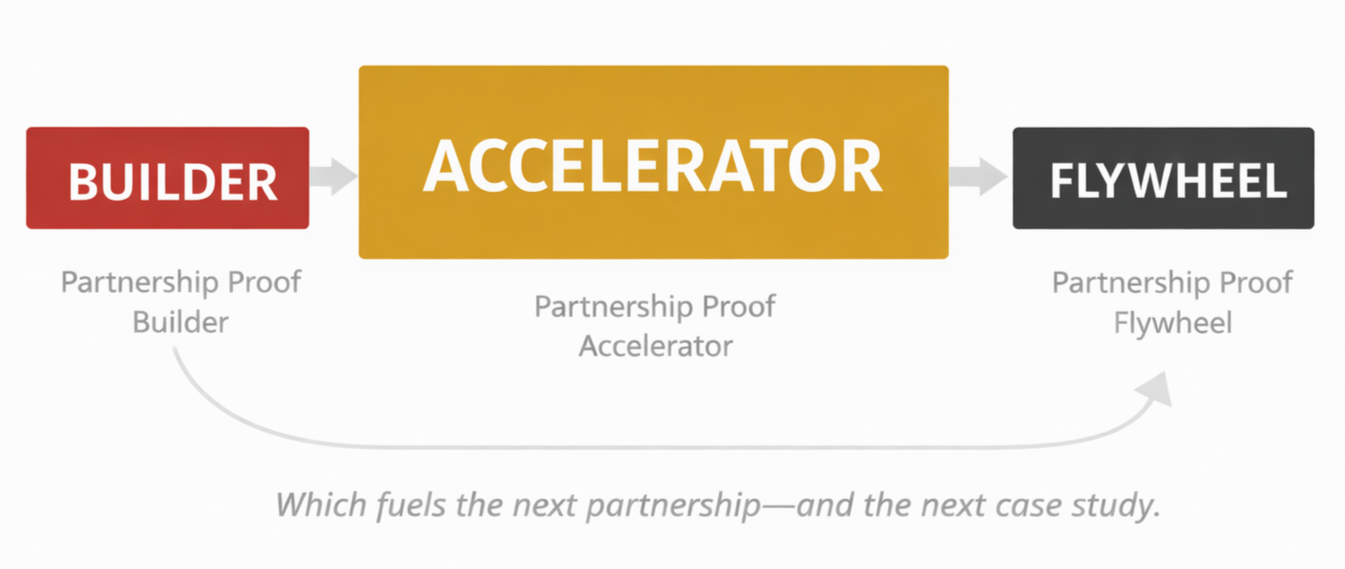
If the Builder is about creating your first piece of proof, the Accelerator is about using that proof to unlock what comes next.
This stage is for nonprofits that already have something real:
✔️ A completed partnership
✔️ A campaign that worked
✔️ Results they’re proud of—but aren’t fully using
Instead of jumping back into cold outreach or chasing the next “big idea,” we slow down just enough to extract value from what you’ve already done.
In the Accelerator, we focus on three things:
➡ Turning your partnership into a clear, credible case study
➡ Translating results into language companies actually care about
➡ Using proof to shorten sales cycles and open warmer doors
The goal isn’t more activity.
It’s more traction. ⚙️⚙️
A strong case study changes everything. It gives you confidence. It offers prospects clarity. It shifts conversations from “Could this work?” to “How would this work for us?”
And once proof is visible, partnerships stop feeling like a grind.
Outreach gets easier.
Follow-ups feel natural.
Companies lean in faster—because they can see themselves in the story.
That’s the work of the Partnership Proof Accelerator.
It’s not about chasing more partnerships.
It’s about making the ones you’ve already earned do more work for you.
If the Builder helped you create proof, the Accelerator helps you activate it.
👉 If this sounds like where your organization is right now, just reply to this email.
In my next newsletter, I’ll walk through the final stage of the system—the Partnership Proof Flywheel—where proof compounds and partnerships start feeding each other.
✍️ Partnership Notes
A partnership insight that matters.
🧾 BBBS shows what 'proof over persuasion' looks like in practice.
If partnerships are shifting from persuasion to proof, this Atlantic-sponsored interview with Artis Stevens, President & CEO of Big Brothers Big Sisters of America, shows exactly what that looks like for nonprofits. Instead of relying solely on emotion, BBBS frames mentorship as a long-term investment—backed by outcomes, evidence, and real-world impact. This piece speaks the language partners trust: value, durability, and return. It’s a strong reminder that when proof is clear, you don’t have to convince partners. They convince themselves.
🤑 Marketing Your Cause
One move nonprofits should steal.
🥩 Why keeping your content raw beats AI efficiency
Dick's Sporting Goods is doubling down on human creators—not AI—to drive its sports content strategy, betting that authenticity and credibility outperform speed and scale. The approach shows how trusted voices build emotional connection and long-term loyalty in ways AI-generated content can’t—at least not yet. For nonprofits, the lesson is clear: don’t rush to automate your voice. Invest in real storytellers—partners, beneficiaries, staff—who bring lived experience and trust to your message. In cause marketing, credibility isn’t a nice-to-have; it’s the asset that makes everything else work.
😎 Cool Jobs in Cause
Find your next adventure.
🤝 Director, Corporate Partnerships (2 Positions), Points of Light, Remote ($100k-$115k)
🤝 Corporate Partnerships Manager, United Food Bank, Mesa, AZ
🤝 Director of Corporate Partnerships, Trees Upsate, Remote/Upstate South Carolina
🧠🍌 Brain Food
What's feeding my thinking.
📉 Individual giving is tightening—and that changes the fundraising math.
A recent survey found that 1 in 4 Americans plan to cut back on charitable giving in 2026, driven by inflation and economic uncertainty. That doesn’t mean donors don’t care—but it does mean nonprofits can’t rely solely on individual giving. This is why partnerships matter more than ever. Corporate partners bring diversification and shared value when traditional giving is under pressure. It’s also where cause marketing can shine—point-of-sale asks rely on spare change or a few dollars, lowering the barrier to giving when larger gifts feel harder to make. In a tighter fundraising environment, partnerships aren’t a “nice add-on”—they’re part of a resilient revenue strategy.
