
Newsletter: Beware of Partnership Fish Stories 🎣 ; The Era of Passive Sponsorship is Over 🥱 ; People Trust People, Not Marketing 👥
I recently read a Forbes article about a businessman and a charity fundraiser he helped build. Honestly, what caught my attention wasn’t the person. It was the lesson.
To be clear, the issue wasn’t whether good was done. By most accounts, significant money was raised for a worthy cause.
The issue was whether the public story accurately reflected what happened.
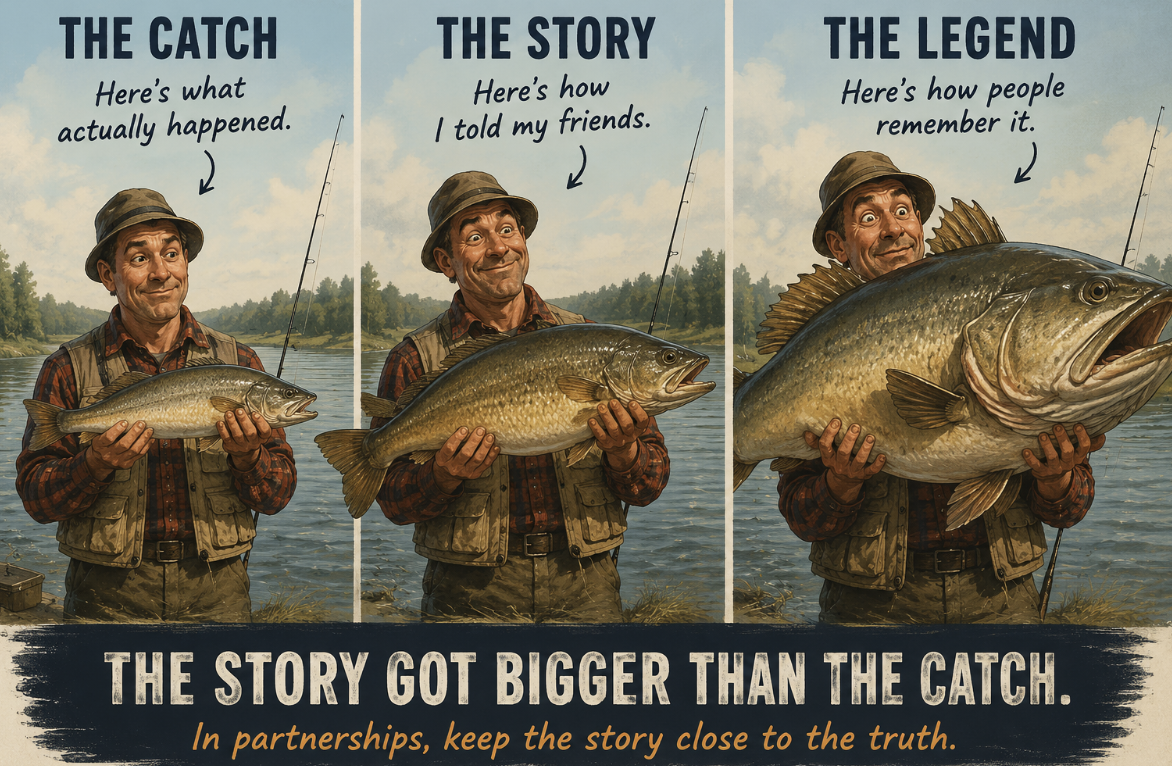
👉🏻 That’s an important distinction. And it’s one that partnership professionals should pay attention to.
One thing I’ve learned after studying hundreds of nonprofit-business partnerships is that reality is usually impressive enough.
You don’t need to inflate the numbers or embellish the results. You sure as hell don’t need to turn a good partnership into a miracle.
Yet nonprofits—and companies—do this ALL. THE. TIME.
🙄 A few hundred participants suddenly become “millions of impressions.”
🙄 A campaign raises $100,000 and somehow becomes “transformational.”
🙄 A meaningful contribution starts sounding bigger than the actual results.
The problem isn’t just accuracy. It’s trust. Partnerships are built and sustained on credibility.
The moment a partner starts wondering whether the numbers are real, whether the outcomes are being exaggerated, or whether the story matches reality, the relationship changes.
In partnerships, I see three credibility killers over and over again:
👉 Taking too much credit.
👉 Making claims you can’t verify.
👉 Turning assumptions into facts.
That’s one reason I’m so obsessed with proof.
In fact, it’s the foundation of my Partnership Proof System (PPS).
Friends, proof isn’t marketing. Proof is what remains after the marketing is stripped away.
Case studies. Verified results. Testimonials. Documented outcomes.
Those things don’t just help you win partnerships. They help you keep them.
The strongest partnership professionals I know do something that feels almost old-fashioned these days.
They understate. They verify. They document.
Then they let the results speak for themselves. Because a good story can get attention.
But only the truth can sustain a partnership.
✍️ Partnership Notes
One partnership insight that matters.
🥱 The era of passive sponsorship is over.
In an interview with The Drum, leaders at this legendary beer brand argue that simply putting a logo on an event is no longer enough. Today’s most effective sponsorships create experiences, spark participation, and give people something to remember and share. The takeaway for partnership teams: companies increasingly want more than visibility. They want engagement! That means the best sponsorship opportunities don’t just offer impressions; they offer ways for employees, customers, and communities to interact with the brand. In other words, sponsors don’t just want to be seen anymore. They want to be part of the story.
🤑 Marketing Your Cause
One move you should steal.
👥 People trust people more than they trust marketing.
A HubSpot article on social proof is a reminder that persuasion often comes from seeing what others have already chosen, endorsed, or experienced. Think of the famous hotel towel study: guests were more likely to reuse towels when told that previous guests in the same room had done the same. The lesson wasn’t about towels—it was about people following people. The takeaway for nonprofit marketers: don’t just tell people you’re effective. Show them who already believes in you. Case studies, testimonials, partner logos, and success stories all work because trust is easier to earn when someone else lends it to you first.
😎 Cool Jobs in Cause
Find your next adventure.
🤝 Director, Corporate Partnerships, Segerstrom Center for the Arts, Orange County, CA
🤝 Senior Director of Corporate Partnerships, Adrienne Arsht Center for the Performing Arts of Miami-Dade County, Miami-Dade County, FL
🤝 Senior Corporate Development Officer, Habitat for Humanity International, Remote
🧠🍌 Brain Food
One thing that is feeding my thinking.
🏃♀️ Your brain needs exercise too.
A fascinating BBC Future article explores what neuroscience says about staying mentally sharp in a rapidly changing world. The research suggests that one of the best ways to future-proof your brain isn’t memorizing more information—it’s regularly exposing yourself to new ideas, challenges, and experiences. The takeaway for nonprofit leaders: curiosity may be one of the most valuable professional skills you can develop. In a world where knowledge is increasingly accessible, the people who thrive won’t necessarily know the most. They’ll be the ones most willing to keep learning.
