
Newsletter: Cause Marketing is the Cherry, Not the Sundae 🍒 ; Want Better Prospects? Think Smaller 🤏🏻 ; Get to Know the People on Your Email List 🔎
Remember the kid in the movie The Sixth Sense who said, “I see dead people”?
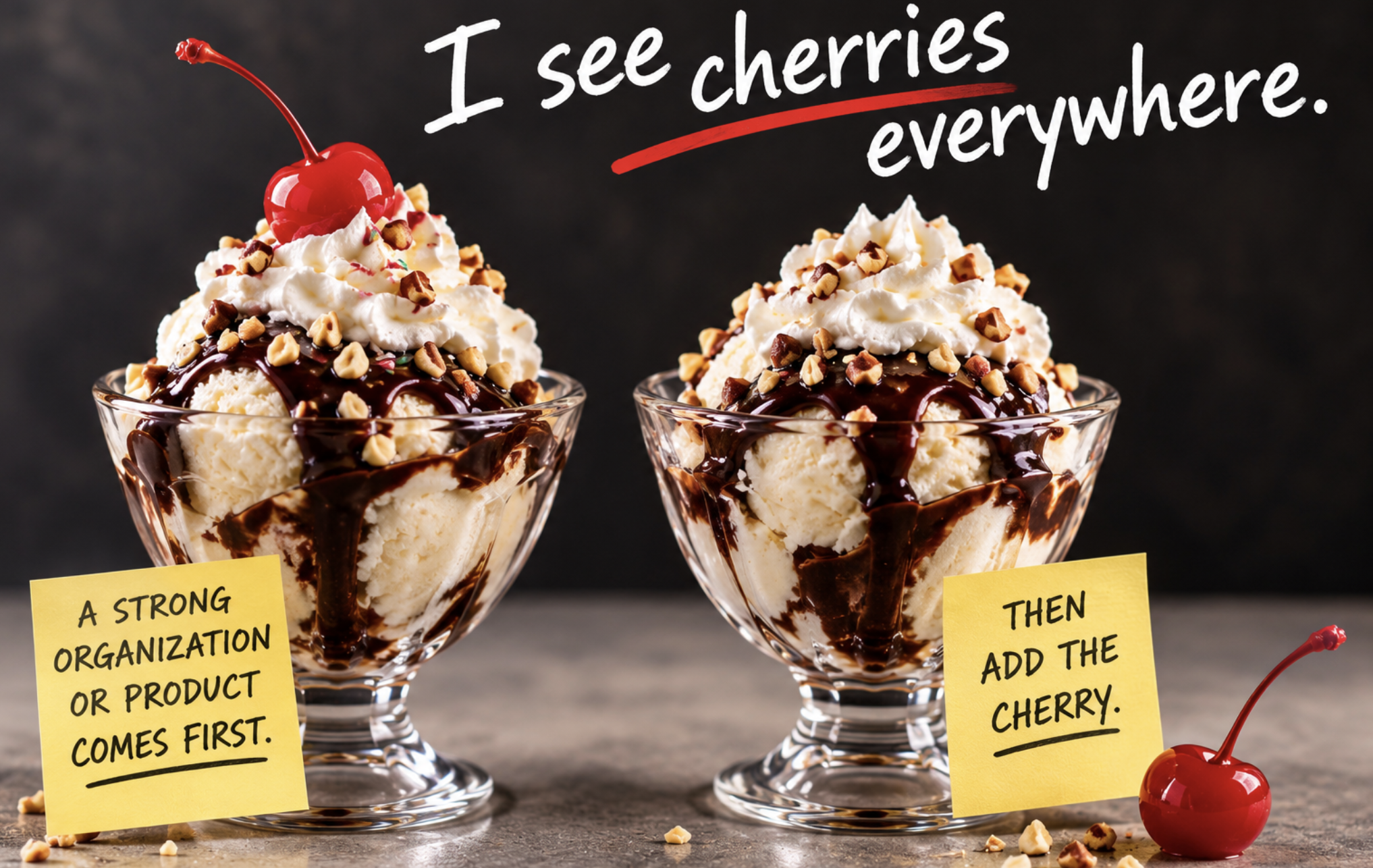
Well, lately I see cherries––everywhere.
A few weeks ago, I wrote that corporate partnerships are like the cherry on top of a hot fudge sundae. You don’t start with the cherry. First you need a great organization with strong programs, loyal supporters, measurable impact, and a reputation for getting things done.
Build the sundae. Then add the cherry.
Well, I've had another cherry sighting.
Aimee Smith, director of partnerships and business development at Healthy Family Project, recently shared some interesting consumer research on their long-running Produce for Kids cause marketing campaign.
For years, she writes, companies have wanted to know whether cause marketing actually sells more stuff.
It turns out that may be the wrong question.
Among shoppers who knew about Produce for Kids, 93% said it improved their perception of the retailer, 83% said it increased their likelihood of shopping there, and 80% said they were more likely to recommend the retailer.
That's pretty impressive.
But here’s the number that caught my attention:
70% said they would purchase the same produce they had already intended to purchase regardless of the campaign.
In other words, cause marketing wasn’t magically creating customers.
It was making existing customers feel better about a choice they were already making.
Sound familiar?
🍨 The sundae was already there. Cause marketing was the cherry on top.
That’s an important distinction because nonprofits sometimes sell cause marketing as if supporting a good cause will suddenly make people buy a product they don’t want from a company they don’t like.
It won’t.
Price matters. Quality matters. Convenience matters. The product matters. The company matters.
Cause marketing can then add something incredibly valuable: trust, loyalty, differentiation, and another reason for customers to choose you again.
And there’s one more lesson in Aimee’s research: people have to know about the partnership. If you bury the cherry under the whipped cream, what’s the point?
(On a side note, literally burying a cherry under mounds of whipped cream sounds absolutely fricken delicious to me.😋)
So I’m sticking with my sundae theory.
Partnerships don’t rescue weak nonprofits. And cause marketing doesn’t rescue weak businesses.
But when the business is already strong? Cause marketing can make something good even better.
It’s the cherry on top! 🍒
✍️ Partnership Notes
A partnership insight that matters.
👖 Want better corporate prospects? Think smaller.
Children’s Medical Research Institute wanted to grow corporate support for its Jeans for Genes campaign. Instead of blasting hundreds of generic pitches, it narrowed its focus to retail companies and sent about 100 carefully chosen prospects a memorable package featuring a tiny pair of denim baby jeans. A QR code led recipients to a personalized video invitation. The campaign generated meetings, new partnerships—and an industry award for prospecting.
Joe’s Take: I love this because the strategy wasn’t about more prospects. It was better prospects, approached better. Too many nonprofits build enormous corporate lists and then send everyone the same pitch. Flip that around. Pick an industry where you have a compelling reason to partner, identify a manageable group of companies, and create outreach specifically for them. Test it. Learn from it. Then scale what works. The goal isn’t to reach more companies. It’s to give the right companies a reason to respond.
🤑 Marketing Your Cause
One move you should steal.
🪜 How well do you really know the people on your email list?
Most organizations spend a lot of time trying to grow their email lists. But Dan Oshinsky of Inbox Collective argues that there’s another opportunity hiding in plain sight: learning more about the people already on your list. His “User Ladder” is a simple strategy for gradually collecting information about subscribers—their interests, needs, behaviors, and preferences—so you can communicate with them more effectively.
Joe’s Take: An email address tells you almost nothing about a person. So instead of always asking, “How do we get more subscribers?” ask, “What do we wish we knew about the subscribers we already have?” Then start learning—one question in a welcome email, a quick survey, an interest preference, or information gathered when someone registers for an event. You don’t need to know everything at once. Climb the ladder one rung at a time. The more you know about your audience, the less you have to guess about what they want.
😎 Cool Jobs in Cause
Find your next adventure.
🤝 Director of Corporate Partnerships, Coral Gardeners, California
🤝 Senior Director of Corporate Partnerships, National Forest Foundation, Missoula, MT
🤝 Senior Director, Corporate Partnerships & Events, Brigham and Women's Hospital, Boston
🧠🍌 Brain Food
One thing that is feeding my thinking.
🧠 What if giving wasn’t something your company did—but why it existed?
More than 40 years ago, Paul Newman helped create one of the strangest business models around: Newman’s Own would give away 100% of its after-tax profits rather than enriching its owners. Now a new generation of entrepreneurs is experimenting with the same idea. Hank and John Green’s Good Store has already directed more than $10 million to charitable causes, while other founders are committing a percentage of profits or even restructuring their companies around giving.
Joe’s Take: We’re used to thinking of business and philanthropy as two separate things: first a company makes money, then it decides how much to give away. Newman flipped that equation. The business itself became the fundraising engine. I’m not suggesting every company should—or could—give away 100% of its profits. But it’s an interesting question to ponder: How different would business look if social impact weren’t something companies added after they became successful, but something they were designed to produce from the beginning?
