
Newsletter: AI Readiness Workbook for Partnership Teams 🤖 ; Sub Chain's ‘Extinguisher’ Turns Gravy Into Giving 🧯; Adopt a Ranger, Save the Parks ✊
I’ve been thinking a lot about something AI smahhty pants and beantown boy Christopher Penn wrote in a recent Almost Timely News issue: before AI can improve your [partnership] sales efforts, you need to understand three things: Who you sell to, what you sell, and how you sell.
That framework hit me like a well-aimed Dunkin’ cup. Doh!🥤😖
Most partnership teams want to jump straight to prompts—"Write me an outreach email" or "Summarize this call"—without realizing that AI can’t fix what isn’t defined.
If your ideal partner profile is fuzzy, your value proposition is vague, or your results are scattered, even the best AI prompt amplifies the noise.
That’s why I created the AI-Readiness Workbook for Partnership Teams.
It’s a fill-in-the-blanks field guide to make sure your team has the raw material AI needs to actually think with you: partner profiles, value propositions, results data, offers, and stories. When those pieces are in place, generative AI becomes a real sales coach and not a parlor trick.
And here’s the cool part: if you’ve worked with me on case studies—or want to work with me on them in 2026 🙏—you'll already be 80 percent done!
➡️ New Case Study Drop: Big Brothers Big Sisters & NH Martial Arts Studios ⬅️
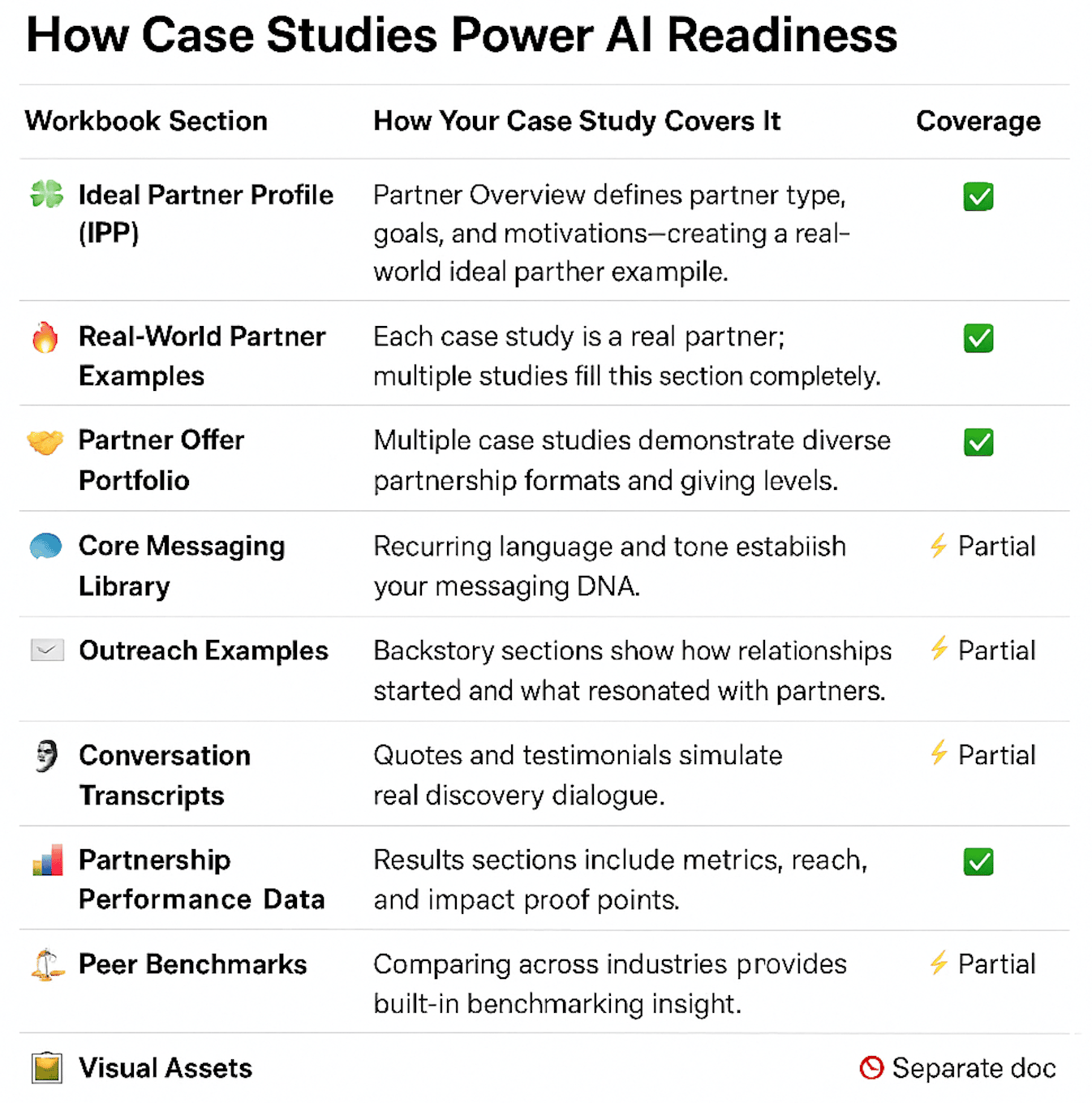
So before you ask AI for better results, make sure it has something worth analyzing. Because AI can’t sell your partnerships until it understands your story—and that’s exactly what the workbook can help you write, even if you don't use case studies.
However, here's the upside of completing the workbook with case studies: Every case study I write moves your partnership team closer to AI readiness. They don’t just tell stories; they build the structured data AI needs to understand who your partners are, what you offer, and how you deliver results.
Just hit reply to this email and tell me how I can help!
Download: AI-Readiness Workbook for Partnership Teams
✍️ Partnership Notes
In my "Partnership Notes" section, I share stellar corporate partnership programs and show you how to do your job better!
1. Sub chain's "Extinguisher" turns gravy into giving.
💡 To mark the 20th anniversary of its foundation, Firehouse Subs launched a limited-edition gravy extinguisher—a bottle of gravy sold for $20, with 100 percent of proceeds funding lifesaving equipment for first responders. It’s a textbook cause product, which I define as a product created specifically to support a cause (as opposed to a purchase-triggered donation, which is an everyday product that benefits a cause). BTW, my all-time favorite example of a cause product is White Castle's hamburger-and-onion-scented candle for Autism Speaks.
2. What shopping carts can teach us about point-of-sale fundraising.
💡 This deep dive into why people don’t return shopping carts reveals a truth that applies to checkout giving too: people copy what they see—and what they think others expect. In line or online, if customers don’t see generosity modeled, they’re less likely to donate. The fix? Build social proof into every point-of-sale campaign. Show real-time totals, display how many others have given, and use language that makes rounding up feel like kindness, not obligation. When giving feels visible, social, and meaningful, more shoppers “return the cart.”
3. ADF's partnership pitch deck and webpage show real promise.
💡 I came across this pitch deck for the Arbor Day Foundation (ADF) via ESG Dive, so I jumped over to ADF's corporate partnership page, and there's a lot to like. Using the October AI prompt I shared in my 7 Credibility Builders for Partnership Websites post (the one that grades trust signals), ADF's website got a B-, but they are just a few tweaks away from earning a straight A. Their positioning is strong, their value prop is clear, and the proof points are already there. They just need to tighten a few credibility elements to stand out as a top-tier partner destination!
🤑 Marketing Your Cause
In my "Marketing Your Cause" section, I share strategies for growing your brand and audience—two key ingredients for securing more partnerships.
1. Survey first—guess later. 🔐 (🔐 = I can email you this article)
💡 Designing a survey might feel like a checkbox, but according to this article, flawed questionnaires lead to flawed data. The article walks you through essentials: define your audience and sample, segment informed stakeholders separately, avoid yes/no traps, and let dissenting voices speak up.
2. What local newsrooms can teach nonprofits about social growth.
💡 This article was written for local publishers, but the playbook applies to nonprofits, too: stop chasing every platform and double down on the one or two that actually move the needle. Swap “newsroom” for “nonprofit,” and the insight holds—your mission won’t spread if your message is spread too thin. The piece argues for focusing on high-performing evergreen content, creating “social-first” packages that are easy to share, and, this is key gang, using your newsletter as the conversion engine behind it all.💥
3. When will nonprofits finally treat marketing like mission-critical work?
💡 A new report on U.S. art museums found that many spend shockingly little on marketing—often just enough to announce exhibits, not enough to build audiences or deepen engagement. And museums aren’t alone: plenty of nonprofits still treat marketing as optional instead of essential.
😎 Cool Jobs in Cause
In my "Cool Jobs in Cause" section, I share open partnership positions so you can discover your next adventure.
1. Director of Strategic Partnerships, Monterey Bay Aquarium, Monterey, CA ($140k-$180k)
2. Associate Director of Corporate Engagement, The Nature Conservancy, Durham, NC
3. Director, Corporate Partnerships, Points of Life, Remote ($85k-$90k)
4. Development Manager, Partnerships & Corporate Giving, Move for Hunger, Remote ($65k + Bonus)
5. Director of Sponsorships & Fundraising, Netroots Nation, Remote
🧠🍌 Brain Food
In my "Brain Food" section, I share things that spark inspiration, fuel curiosity, and bring a smile to your face!
1. Is billionaire influence the Met Gala’s biggest fashion risk?
💡 Jeff Bezos and Lauren Sánchez are stepping in as the lead sponsors of the 2026 Met Gala, and the reaction isn’t all sparkle and couture. Their involvement breaks a decades-long tradition in which legacy fashion houses have funded and shaped the event. It's a shift that could pull the gala away from its creative roots and toward the ambitions of ultra-powerful tech elites. The deeper worry is cultural: as a few billionaires gain control over major creative institutions, the independence and identity of those institutions can get blurred.
2. Three words: Cheetah. Cub. Cam.
💡 Take a break from doomscrolling and watch Amabala, a 5-year-old cheetah at the Smithsonian Conservation Biology Institute, caring for her four newborn cubs (born Oct. 17). It’s pure, uninterrupted joy, and a reminder that sometimes the best Brain Food is wonder, not work.
3. Adopt-a-ranger is the kind of idea we need right now.
💡 I love this idea so much, I’ve already signed up to “adopt a ranger.” With the current federal budget cuts, no one has gotten screwed more than rangers and the National Park Service, the hands-down most popular government agency, and the people literally keeping our most treasured places alive.
The new Adopt-a-Ranger Program lets the public step in with support kits, notes of encouragement, and a real sense of connection. Please, please support our parks and our rangers!
My favorite national park is Minute Man National Historical Park. Pictured is the Old North Bridge in Concord, Massachusetts—the site of the first pitched battle of the American Revolution, 250 years ago this year. Huzzah!

